The First 7 Days on Market (San Jose): What We Track Daily to Adjust Fast
Home Seller
Home Seller
When a San Jose home goes live, the first 7 days matter more than most sellers realize.
That does not mean every home should receive offers in the first week. It also does not mean a seller should panic if an offer does not show up immediately. San Jose is too specific for that kind of blanket advice. The right response depends on the property type, price point, neighborhood, condition, competition, showing access, and the seller’s goals.
But here is what I have learned after years of helping San Jose homeowners sell: the first week gives us some of the clearest signals we will ever get.
Buyer behavior is fresh. Agent attention is high. Online activity is strongest. Competing listings are easier to compare. Feedback is usually more honest. And if something is off, the first 7 days give us a chance to diagnose it before the listing loses momentum.
That is why my approach at Real Estate 38 is not “set it and forget it.” Once a home goes live, we track the market daily. We look at the numbers, the feedback, the showings, the competition, and the intent signals so we can protect pricing confidence, buyer demand, seller leverage, and ultimately, net proceeds.
If you are preparing to sell, I recommend starting with my full seller guide here: Sell Your Home San Jose Guide. If you are closer to listing, you can also learn more about our selling process here: Sell With Real Estate 38.
The first 7 days are critical because this is when your listing gets the most initial exposure.
In San Jose, serious buyers are usually watching the market closely. Many have alerts set up. Their agents are tracking new listings daily. When a home hits the MLS, it gets pushed to real estate websites, buyer search portals, agent inboxes, email alerts, and social feeds.
That launch window creates a burst of attention.
The question is not just, “Did people see the listing?”
The better question is, “How did the market respond once they saw it?”
A strong first week can create confidence. It can lead to showings, agent calls, disclosure requests, repeat visits, and offer conversations. A weak first week can tell us that something may need to be adjusted, whether that is price, presentation, access, photography, staging, marketing language, condition, or buyer targeting.
The goal is not to react emotionally. The goal is to read buyer behavior early.
Buyers pay attention to days on market.
When a listing is brand new, buyers often feel a sense of urgency. They know other buyers may be looking at the same property. They know a well-priced home in a strong San Jose neighborhood can move quickly. That urgency can create better showings, more serious conversations, and stronger negotiation leverage.
As days on market increase, buyer perception can change.
Some buyers start wondering:
“Why is this still available?”
“Is it overpriced?”
“Is there something wrong with the home?”
“Will the seller negotiate?”
That is why the first week is so important. It sets the tone. It influences how buyers view the property, how agents talk about it, and how much leverage a seller may have if an offer comes in.
This is especially important in San Jose because buyer behavior can shift by neighborhood and property type. A move-in-ready single-family home in a desirable school area may behave differently than a dated condo, a tenant-occupied townhome, or a home with access limitations.
A lot of sellers think the work is done once the home goes live.
In reality, that is when the next phase begins.
Before launch, we focus on pricing, preparation, staging, photography, disclosures, positioning, and marketing. After launch, we focus on market response.
That response tells us whether the strategy is working.
At Real Estate 38, I want to know what buyers are doing, not just what they are saying. A buyer may say they like the home, but their behavior tells us more. Did they schedule a showing? Did they come back for a second look? Did their agent request disclosures? Did they ask specific questions? Did they compare the property to another listing? Did they talk about offer timing?
Those details matter.
The first week is where strategy meets the real market.
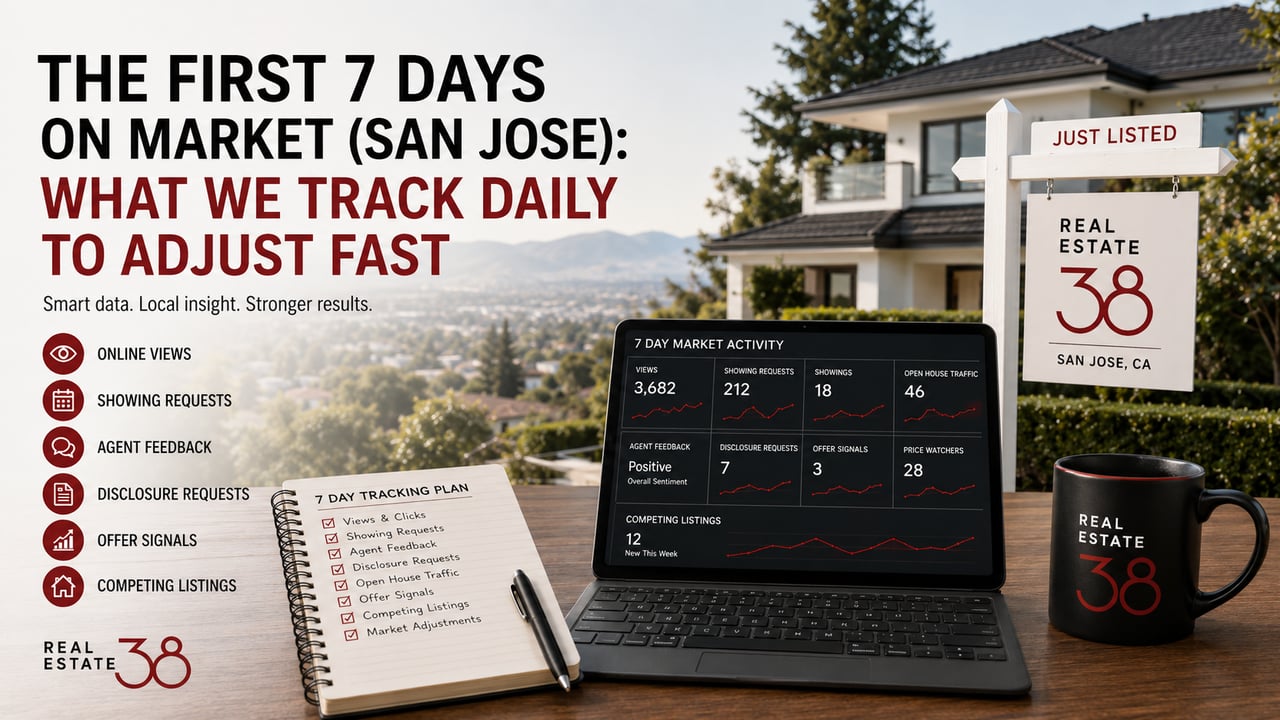
Once a home is live, I track both digital activity and real-world buyer behavior.
Here are the key signals I watch closely:
Online views tell us how many people are seeing the home.
High views are good, but they are only the first layer. A listing can get a lot of views because the price is attractive, the photos are strong, the location is in demand, or the property has features buyers want.
But high views alone do not mean buyers are ready to act.
If views are high but showings are low, that may signal a disconnect. Buyers may be curious, but something is stopping them from scheduling a visit.
That issue could be price, condition, layout, location, HOA dues, tenant occupancy, photography, marketing language, or a mismatch between the listing and the buyer pool.
Saves, clicks, and shares tell us whether buyers are interested enough to come back to the listing.
A save is usually stronger than a view. It means the buyer may be comparing the home against other options. A share may mean the buyer is sending it to a spouse, family member, agent, or decision-maker.
These signals are not offers, but they help us understand whether the home is making it into the buyer’s consideration set.
If a listing has views but very few saves or shares, it may mean buyers are looking but not connecting.
Showing requests are one of the most important early signals.
If buyers are serious, they usually want to see the home in person. In San Jose, strong showing activity in the first few days can indicate that the price, presentation, and location are aligned with demand.
If showing requests are low, we need to ask why.
Is the price too aggressive for the condition?
Are buyers choosing competing homes instead?
Is access too difficult?
Are the photos not creating enough urgency?
Is the home targeting the wrong buyer pool?
Low showing activity does not automatically mean the price is wrong, but it does mean we need to investigate quickly.
Open house traffic gives us a real-time read on buyer interest.
But open house traffic has to be interpreted carefully.
A busy open house can be a great sign, but not every visitor is a serious buyer. Some people are neighbors. Some are early-stage buyers. Some are browsing. Some are not qualified yet. Some are agents previewing for clients.
That is why I do not just count bodies through the door. I look at the quality of the traffic.
Were visitors asking specific questions?
Did they stay longer than usual?
Did they bring their agent?
Did they ask about disclosures?
Did they ask about offer timing?
Did they compare the home to other active listings?
Did anyone return for a second look?
That is where the real information is.
Agent feedback is often more useful than buyer feedback because agents know what their clients are comparing.
A buyer may simply say, “It feels too small” or “We are still thinking about it.”
An agent may tell us something more helpful, such as:
“My clients liked the home, but they are concerned about the disclosure package.”
“They are comparing it to another home in Cambrian with a larger lot.”
“They liked the layout, but they feel the price is high based on condition.”
“They would have written if the home had been vacant and easier to tour.”
“They are interested but want to see what else comes up this weekend.”
That kind of feedback helps reveal hidden objections.
Buyer comments can be useful, but sellers have to be careful not to overreact.
One bad comment does not define the market.
One buyer may dislike the flooring. Another may love it. One buyer may think the kitchen is dated. Another may see it as a chance to personalize the home. One buyer may complain about the yard size. Another may value low maintenance.
This is why I look for patterns, not isolated opinions.
If one person says something negative, we note it. If five buyers and three agents say the same thing, now we have a signal.
Disclosure requests are one of the strongest intent signals.
In San Jose, serious buyers usually want to review disclosures before making an offer. If buyers are downloading disclosures, asking questions, and having their agents review the details, that tells us the listing is generating real consideration.
A home with high traffic but no disclosure activity may be getting attention without serious intent.
A home with moderate traffic but strong disclosure activity may be attracting fewer buyers, but better-qualified buyers.
That distinction matters.
Serious buyers ask different questions than casual buyers.
Casual buyers may ask surface-level questions about square footage, schools, or open house timing.
Serious buyers ask about inspections, permits, seller timing, offer deadline, HOA documents, repair history, disclosures, roof age, foundation, drainage, remodel work, insurance, financing, appraisal risk, and competing interest.
When those questions start coming in, we pay attention.
That does not guarantee an offer, but it often means the buyer is moving from curiosity to evaluation.
Repeat showings are one of the clearest signs of buyer interest.
A buyer who comes back a second time is usually trying to make a decision. They may be bringing a spouse, parent, contractor, inspector, or agent. They may be comparing the property against one or two other homes.
Repeat showings are important because they tell us the home has made the shortlist.
If a home is getting repeat showings but no offers, we need to dig deeper. The issue may be price resistance, condition concerns, disclosure concerns, financing uncertainty, or stronger competing options.
Offer signals can appear before the actual offer.
An agent may ask:
“Do you have offers yet?”
“When are you reviewing?”
“How many disclosure packages have gone out?”
“What is the seller looking for?”
“How flexible is the seller on terms?”
“Would the seller consider a preemptive offer?”
These questions matter because they help us understand buyer psychology and possible leverage.
A strong launch often creates more direct offer conversations. A softer launch may create more probing questions from buyers trying to see if the seller is flexible.
Competition can change everything during the first week.
A home does not sell in a vacuum. Buyers compare your property to whatever else is available at the same time.
If a similar home hits the market two days after yours, we need to evaluate it immediately. Is it priced lower? Better staged? Larger? Newer? In a better school boundary? Offering better terms? Easier to show? More updated?
In San Jose, competition can shift quickly, especially in areas like Cambrian, Willow Glen, Almaden Valley, Berryessa, Evergreen, Blossom Valley, Santa Teresa, Rose Garden, Downtown San Jose, and nearby Silicon Valley markets.
If a new competing listing changes buyer perception, we need to know early.
Strong activity usually looks like a combination of signals, not just one metric.
A strong first week may include:
High online views
Strong saves and shares
Multiple showing requests
Healthy open house traffic
Positive agent feedback
Disclosure downloads
Specific buyer questions
Repeat showings
Offer conversations
When these signals line up, the strategy is usually working. In that case, the seller may need to stay patient and allow the process to develop.
Not every buyer writes immediately. Some need to review disclosures. Some need lender confirmation. Some want to compare weekend inventory. Some are waiting to see whether there is an offer deadline.
Strong activity does not always mean instant offers, but it does mean the market is engaging.
Weak activity also has patterns.
If views are low, the listing may not be reaching enough buyers or the online presentation may not be compelling.
If views are high but saves are low, buyers may be curious but not emotionally connecting.
If saves are high but showings are low, buyers may be hesitating because of price, access, location, HOA dues, condition, or buyer-fit concerns.
If showings are happening but offers are not, buyers may be seeing something in person that is creating resistance.
If disclosures are being downloaded but buyers are not moving forward, there may be a concern in the disclosure package, inspection reports, HOA documents, property condition, or pricing relative to risk.
The key is to diagnose the issue correctly.
A weak first week does not always mean “drop the price.” Sometimes the fix is presentation. Sometimes it is access. Sometimes it is clearer marketing language. Sometimes it is new photography. Sometimes it is staging. Sometimes it is a repair. Sometimes it is a disclosure explanation. Sometimes it is price.
The data tells us where to look.
High views with low showings is one of the most important patterns to watch.
This usually means buyers are seeing the home online, but not taking the next step.
That could point to several issues:
The price may feel too high compared to the photos or condition.
The photos may not be strong enough to create urgency.
The home may have a feature that limits the buyer pool.
The description may not be positioning the property clearly.
The showing instructions may be too restrictive.
The property may be competing with better options at the same price.
The buyer pool may be thinner for that home type or price point.
For example, a tenant-occupied property with limited showing access may get online interest but fewer in-person visits. A dated home may get curiosity clicks but fewer showings if buyers feel the price does not reflect the work needed. A condo may get views but fewer showings if HOA dues, parking, or financing concerns create hesitation.
This is why we do not just celebrate views. We track conversion.
Showings without offers tell a different story.
In that case, buyers are interested enough to visit, but something is stopping them from writing.
The possible reasons include:
Price resistance
Condition concerns
Layout objections
Disclosure concerns
Inspection concerns
HOA concerns
Competition from similar listings
Lack of emotional connection
Unclear value compared to other homes
Showing experience not matching the online presentation
This is where agent feedback becomes critical.
If buyers are walking through but not writing, I want to know what changed when they saw the home in person.
Did the home feel smaller than expected?
Was the condition different than the photos suggested?
Were buyers concerned about repairs?
Did they like the home but prefer another option?
Did the price feel too aggressive after touring?
That feedback helps us decide whether to stay patient or adjust.
Open house feedback can be helpful, but not all feedback is equal.
A neighbor’s opinion is not the same as a qualified buyer’s opinion. A casual visitor’s comment is not the same as a buyer who has been writing offers for months. A buyer at the wrong price point may not understand the value of the home. A buyer who wants a turnkey property may not be the right judge of a home that needs updates.
That is why I filter feedback based on source, seriousness, consistency, and market context.
The most valuable feedback usually comes from qualified buyers and experienced agents who are actively comparing the home to other properties.
The least valuable feedback is emotional, random, or isolated.
A seller should never make a major decision based on one negative comment or one slow day.
Days on market matter because they influence leverage.
In the first week, sellers often have the strongest position because the listing is fresh. Buyers do not know how much competition exists yet. They may feel pressure to act before someone else does.
As days on market increase, buyers may become more confident asking for concessions, credits, repairs, or price reductions.
That does not mean a home loses all leverage after one week. San Jose is not that simple. Some homes need more time because of price point, property type, buyer pool, condition, or seasonality.
But in general, the longer a listing sits without strong activity, the more buyers may assume they have room to negotiate.
That is why the first week matters. It helps us protect leverage by catching issues early.
Sometimes the best move is to stay patient.
If the data is strong, I do not want a seller making emotional decisions too quickly.
Patience may be the right strategy when:
Online activity is strong.
Showings are steady.
Open house traffic is healthy.
Agents are giving positive feedback.
Disclosures are being requested.
Serious questions are coming in.
Buyers are returning for second showings.
The home is priced correctly based on competition.
The property type normally takes longer to sell.
In that situation, the market may still be working. The seller may simply need to give buyers time to review, compare, and act.
This is especially true for unique homes, higher price points, tenant-occupied properties, homes with limited showing windows, or properties that appeal to a narrower buyer pool.
Other times, waiting too long can be expensive.
If the first week shows clear resistance, we need to address it before momentum fades.
An adjustment may be needed when:
Views are low.
Views are high but showings are low.
Showings are happening but buyers are not engaging.
Disclosure activity is weak.
Agents are repeating the same objection.
Competing listings are getting more attention.
Open house traffic is below expectations.
Buyers consistently feel the price is too high.
The home is not converting online interest into real-world activity.
In that situation, the worst move is to ignore the market.
The goal is not to panic. The goal is to respond strategically.
An adjustment does not always mean a price reduction.
Depending on what the data shows, we may need to adjust:
Pricing strategy
Photography
Staging
Furniture layout
Marketing language
Showing access
Open house schedule
Disclosures
Repair strategy
Seller credits
Pre-inspection explanations
Online positioning
Target buyer messaging
Property description
Video or social media promotion
Sometimes a small presentation change can improve buyer response. Sometimes better access can increase showings. Sometimes a clearer disclosure explanation can reduce buyer hesitation. Sometimes a repair or credit conversation can keep buyers engaged.
And yes, sometimes the price needs to be adjusted.
But I never want sellers guessing. I want the adjustment to match the actual problem.
One of the biggest mistakes sellers make is comparing their listing to the wrong property type.
A single-family home in a high-demand neighborhood may generate faster activity than a condo with higher HOA dues. A vacant home may be easier to show than a tenant-occupied home. A move-in-ready home may attract more emotional urgency than a dated home that requires work.
Here is how I think about different property types in San Jose:
Single-family homes often get the strongest buyer attention, especially when they are well-priced, well-presented, and located in desirable areas. But even single-family homes need the right launch strategy. If the home is overpriced or competing against stronger listings, buyers will notice quickly.
Condos can be more sensitive to HOA dues, financing, insurance, amenities, parking, reserves, and competition. A condo may need sharper pricing and clearer positioning to stand out.
Townhomes often attract buyers who want more space than a condo but may not be ready for a single-family home. Layout, parking, HOA dues, outdoor space, and commute access can heavily influence demand.
Tenant-occupied homes can be harder to show, and limited access can reduce buyer activity. In those cases, tracking showing friction is critical. If buyers cannot get in easily, the listing may underperform even if the price is reasonable.
Vacant homes are easier to show, but they still need strong presentation. If vacant rooms feel cold or undefined, staging or virtual presentation may be needed to help buyers understand the space.
Dated homes can sell well when priced and positioned correctly. The challenge is helping buyers understand the opportunity without feeling like the seller is asking for a turnkey price.
Move-in-ready homes often generate stronger emotional response, but only if the price matches buyer expectations. Even beautifully prepared homes can stall if the market sees a gap between price and value.
The first week is not static.
A seller can go live on Thursday, and by Friday or Saturday a competing home may hit the market. That new listing may affect buyer behavior immediately.
If a competing home is better priced, better staged, larger, more updated, or easier to show, buyers may shift their attention.
That is why I monitor the competition daily. I look at new listings, price reductions, pending activity, open house traffic, and buyer movement.
The question is always:
“Are we still positioned correctly based on what buyers can choose today?”
Not last month. Not when we first discussed price. Today.
The first 7 days are not about overreacting.
They are about early diagnosis.
If the home is getting strong activity, we want to protect that momentum and make smart decisions. If the home is underperforming, we want to understand why before the listing becomes stale.
A stale listing can create unnecessary negotiation pressure. Buyers may assume the seller is more flexible. Agents may advise their clients to wait. Offers may come in lower. Repair requests may become more aggressive.
The earlier we identify the issue, the more options we have.
That is why the first 7 days are so important.
At Real Estate 38, we combine data, feedback, and local market experience.
Data tells us what is happening.
Feedback tells us why it may be happening.
Experience tells us what to do next.
That combination matters because San Jose real estate is not one-size-fits-all. A home in Willow Glen does not always behave like a home in Evergreen. A Cambrian single-family home is different from a Downtown San Jose condo. A Berryessa townhome is different from a Santa Teresa fixer. A vacant move-in-ready home is different from a tenant-occupied property with limited access.
Local context matters.
My job is to help sellers avoid emotional decisions and make informed ones.
That means we track the right signals, interpret them correctly, and adjust fast when the market tells us to.
Before your home goes live, you should have three things in place:
A launch strategy
A tracking plan
An adjustment strategy
The launch strategy gets the home positioned correctly from day one.
The tracking plan tells us what we are watching daily.
The adjustment strategy helps us respond quickly if buyer behavior shows us something needs to change.
This is how you protect momentum. This is how you protect pricing confidence. This is how you protect leverage. And most importantly, this is how you protect your net proceeds.
If you are thinking about selling in San Jose, do not wait until your home is already sitting on the market to figure this out. The best time to create the plan is before you go live.
You can start with my full seller resource here: Sell Your Home San Jose Guide. You can also learn more about how we help sellers here: Sell With Real Estate 38. And if you are preparing to list, reach out here: Contact Real Estate 38.
The first 7 days can tell us a lot. The key is knowing what to track, how to interpret it, and when to adjust.
For more guidance, review our San Jose home selling process, estimate your home’s value, explore San Jose neighborhoods, or meet Zaid Hanna and the Real Estate 38 team.
Zaid Hanna
408-515-1613
www.re38.com
Stay up to date on the latest real estate trends.

August 24, 2026

August 21, 2026

August 20, 2026

August 17, 2026

August 12, 2026

August 12, 2026
You’ve got questions, and we can’t wait to answer them.