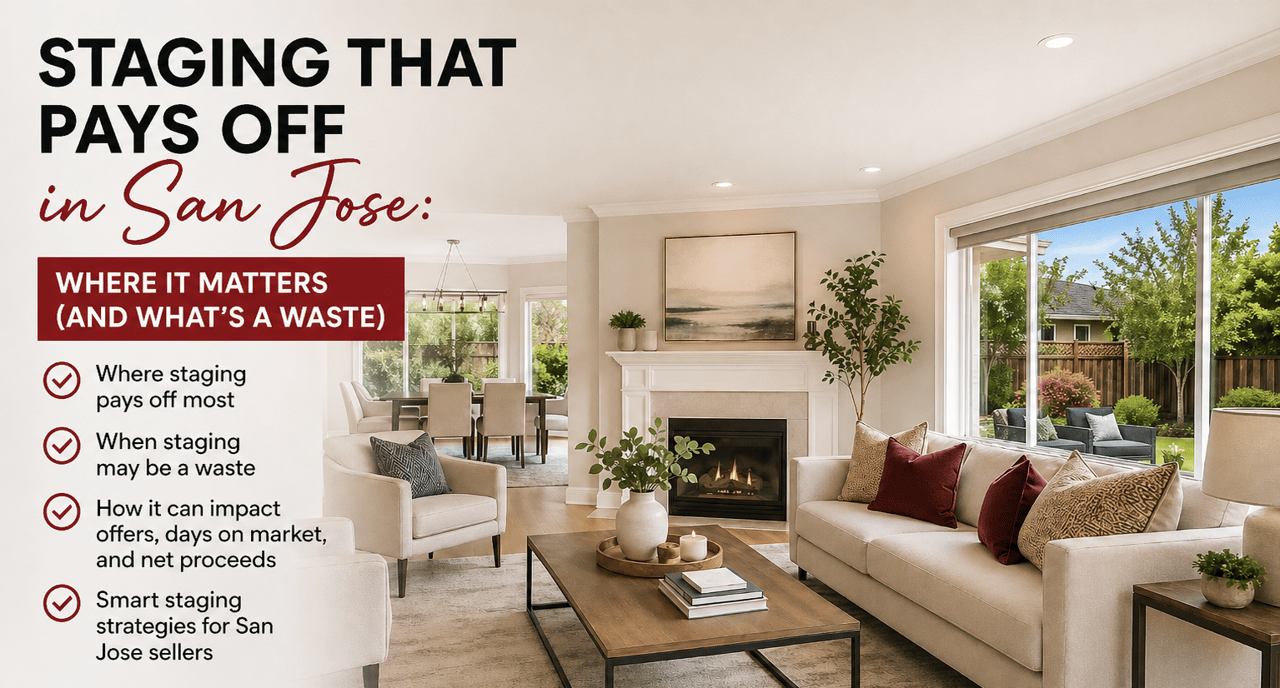
Staging That Pays Off in San Jose: Where It Matters (and What’s a Waste)
Home Seller
Home Seller
When a San Jose seller asks me whether they should stage their home before listing, my answer is usually, “It depends.”
That may not sound exciting, but it is the honest answer.
Staging can absolutely help a home sell faster, photograph better, create stronger buyer emotion, reduce hesitation, and support better offers. I have seen it make a real difference when it is used correctly.
But staging is not magic. It is not automatically worth doing in every room, for every property, at every price point.
The goal is not to spend money just to make the home look pretty. The goal is to spend money only where it improves marketability, buyer confidence, and your final outcome.
That is how I look at staging at Real Estate 38. Before a San Jose listing goes live, we evaluate whether staging will help the property compete better, attract stronger demand, reduce objections, and protect the seller’s net proceeds.
If it will, we use it strategically. If it will not, we do not recommend wasting money.
For sellers who are preparing to list soon, this is one of the most important pre-listing decisions to make before going live. It fits directly into the bigger selling strategy I cover in my San Jose seller guide here: https://re38.com/sell-your-home-san-jose-guide
San Jose buyers are not just buying square footage. They are buying confidence.
They want to understand how the home lives. They want to picture where the sofa goes, where the dining table fits, how the primary bedroom feels, whether the backyard can be used for entertaining, and whether the floor plan works for their lifestyle.
This matters even more in a competitive market like San Jose, where buyers are comparing homes across neighborhoods, price points, school areas, commute routes, and property types.
A buyer might be looking at a single-family home in Cambrian, a townhome in Berryessa, a condo near Downtown San Jose, and a larger home in Almaden or Evergreen all in the same weekend. The homes that feel clearer, warmer, more functional, and easier to imagine living in usually have an advantage.
That is where staging can help.
Good staging does several things:
It improves online photos.
It helps buyers understand scale.
It makes the layout easier to read.
It creates emotional connection during showings.
It highlights the best parts of the home.
It reduces buyer uncertainty.
It helps the property feel more move-in ready.
It can make the home feel more valuable when done correctly.
Most buyers see the home online before they ever step inside. If the photos feel empty, cold, cluttered, dark, dated, or confusing, some buyers may never schedule a showing.
That is why staging is not just about furniture. It is about presentation, positioning, and buyer psychology.
One of the biggest mistakes sellers make is thinking staging is only cosmetic.
Yes, staging should make the home look better. But the real purpose is strategic.
Staging answers buyer questions before they become objections.
Can this living room fit a normal sofa?
Is the dining area actually usable?
Does the primary bedroom feel spacious enough?
How would someone use this awkward corner?
Does this condo feel too small?
Does this older home still feel modern enough?
Can the backyard support the lifestyle buyers want?
When buyers cannot answer those questions, they hesitate. When they hesitate, they offer less, wait longer, or move on to another home.
That is why staging can affect more than just appearance. It can affect buyer demand, days on market, negotiation strength, and final net proceeds.
Not every room needs the same level of investment. In most San Jose homes, the biggest staging impact comes from the spaces buyers emotionally react to first.
The living room is usually one of the most important rooms to stage because it sets the tone for the entire home.
Buyers want to feel the main gathering area. They want to know if it feels comfortable, bright, open, and functional. In many San Jose homes, especially older homes or smaller floor plans, the living room can feel awkward if it is empty.
Staging helps define the room. It gives buyers a sense of scale. It shows how furniture can be arranged. It helps the home feel warm instead of vacant.
For online photos, a well-staged living room can be one of the strongest images in the listing.
The kitchen does not always need furniture, but it absolutely needs presentation.
In many cases, the best “staging” for a kitchen is not adding anything major. It is cleaning, decluttering, lighting, small styling, and making the space feel fresh.
Clear counters. Updated bulbs. Clean appliances. Simple accents. No visual clutter.
If the kitchen is open to the living or dining area, staging the surrounding spaces can make the kitchen feel more connected and functional.
In San Jose, buyers pay close attention to kitchens because they often drive perceived value. A clean, bright, well-presented kitchen can reduce buyer hesitation, especially if the home is not fully remodeled.
Dining areas are often underestimated.
If the dining space is obvious, staging may be simple. But if the dining area is small, shared with another room, or not clearly defined, staging can make a big difference.
This is especially true in condos, townhomes, and smaller single-family homes where buyers need to understand how the layout works.
A staged dining area helps buyers see that the home can support daily living, hosting, and family routines.
The primary bedroom matters because buyers want to feel calm, comfort, and privacy.
A vacant bedroom can sometimes feel smaller than it is. Staging helps show scale and creates a sense of retreat.
In higher price points, primary bedroom presentation becomes even more important because buyers expect a more complete lifestyle experience. For luxury homes in San Jose, the primary suite should feel intentional, elevated, and emotionally compelling.
First impressions matter.
The entryway is where the showing experience begins. It does not always require full staging, but it should feel clean, open, bright, and welcoming.
Sometimes a mirror, small console, plant, rug, or simple styling can change how the home feels within the first few seconds.
That matters because buyers form opinions quickly.
Outdoor spaces can be a major selling point in San Jose because buyers value usable yards, patios, balconies, and entertaining areas.
This does not mean every outdoor space needs expensive furniture. Sometimes the best investment is cleaning, trimming, power washing, adding fresh mulch, improving lighting, or showing a clear seating area.
For single-family homes, backyard presentation can help buyers picture entertaining, kids playing, pets, gardening, or relaxing after work.
For condos and townhomes, staging a balcony or patio can help make the home feel larger and more livable.
Some properties benefit more from staging than others.
Vacant homes often need staging because empty rooms can feel cold, smaller, and harder to understand.
Buyers may not know where furniture should go. They may focus more on imperfections. They may feel less emotional connection.
A vacant home can still sell, but staging often helps create warmth and clarity.
Staging can be very useful for San Jose condos and townhomes because buyers are often evaluating space efficiency.
Does the living area feel large enough?
Can a dining table fit?
Is there space to work from home?
Does the primary bedroom feel comfortable?
Can the patio or balcony be used?
In smaller properties, staging helps buyers understand how to live in the space. That can be the difference between “this feels tight” and “this actually works.”
Older homes can benefit from staging because staging can help bridge the gap between the age of the property and the lifestyle buyers want.
This is especially true if the home has older finishes but good bones. Staging can help buyers focus on layout, light, space, and potential instead of only seeing dated details.
That said, staging should not be used to hide problems. If repairs, paint, lighting, or cleaning are needed, those should usually be addressed first.
Some San Jose homes have additions, converted spaces, unusual room shapes, split levels, or floor plans that are not immediately obvious.
In those cases, staging can be extremely helpful because it gives every space a purpose.
A confusing room becomes an office.
An awkward corner becomes a reading area.
A long room becomes a living and dining combination.
A small bedroom becomes a functional guest room or nursery.
The goal is to remove confusion. Confusion kills buyer confidence.
Staging is not always the best use of money.
There are situations where I would rather have a seller spend their budget on cleaning, decluttering, paint, landscaping, lighting, flooring touch-ups, repairs, or pricing strategy.
Staging may be a waste when:
The home is already beautifully furnished and photographs well.
The property needs obvious repairs that staging cannot overcome.
The home is being sold as a fixer and buyers are focused on renovation potential.
The staging budget is too high relative to the likely return.
The property type or price point does not justify full staging.
Only one or two key rooms need help.
The seller’s existing furniture can be edited and styled effectively.
The market strategy is speed, simplicity, or as-is positioning.
This is where experience matters. Spending $6,000 on staging may make sense for one home and make no sense for another.
The question is not, “Will staging make it look better?”
The real question is, “Will staging improve the sale outcome enough to justify the cost?”
Partial staging is often one of the smartest strategies.
Sometimes a seller does not need to stage the entire home. They only need to stage the rooms that create the most buyer impact.
For example, we may recommend staging:
The living room
Dining area
Primary bedroom
Entryway
Outdoor patio or balcony
Or we may recommend keeping some existing furniture, removing weaker pieces, and bringing in select staging elements to improve the look.
This can be especially effective when the home is occupied, mostly presentable, or only needs help in certain areas.
Partial staging can control cost while still improving the rooms that matter most for photos, showings, and buyer confidence.
Before I recommend staging, I look at the basics first.
A staged home that is dirty, dark, cluttered, or poorly maintained will still create buyer hesitation.
In many San Jose listings, the better return comes from:
Deep cleaning
Window cleaning
Decluttering
Removing personal items
Improving lighting
Fresh interior paint
Touching up baseboards and doors
Fixing small repairs
Improving curb appeal
Refreshing landscaping
Power washing exterior surfaces
Replacing worn carpet
Removing odors
Improving photography prep
These items often create more value than furniture alone.
Staging should enhance the home. It should not distract from deferred maintenance.
If a seller has a limited budget, I would rather spend money first on the items that remove buyer objections. Then we decide whether staging adds enough additional value.
This is the same type of thinking I use across the full preparation process when helping San Jose sellers get ready to list. You can learn more about our selling approach here: https://re38.com/selling
Staging strategy should never be one-size-fits-all.
A Cambrian starter home, a Willow Glen character home, a Downtown San Jose condo, an Evergreen family home, a Berryessa townhome, and a luxury property in Almaden may all require different presentation strategies.
Buyer expectations change depending on:
Price point
Neighborhood
Property type
Condition
Competing inventory
Current buyer demand
School district
Commute convenience
Lot size
Home age
Whether the home is turnkey, dated, vacant, occupied, or as-is
At higher price points, buyers often expect a more polished presentation. Staging can help create the lifestyle feel they are comparing against other premium homes.
For condos and townhomes, staging often helps prove functionality and livability.
For fixer or as-is properties, staging may be less important than cleaning, access, disclosures, contractor insight, and pricing strategy.
For older but well-kept homes, staging can help buyers see the home’s potential without making the property feel like a project.
The right answer depends on the market position.
Staging does not guarantee a higher sale price. No honest agent should say that it always pays for itself.
But staging can help improve the conditions that lead to a better result.
When a home photographs well, more buyers may click.
When more buyers click, more buyers may schedule showings.
When showings feel better, buyers may stay longer.
When buyers understand the layout, they may feel more confident.
When buyers feel confident, they may write stronger offers.
When the home gets stronger early interest, the seller may have more leverage.
That is where staging can matter.
In San Jose, the first week on market is critical. If the presentation is weak, buyers may assume the home is overpriced, less desirable, or not worth prioritizing. If the home sits too long, the seller may face more negotiation pressure or eventually need a price reduction.
Strategic staging can help prevent that by making sure the property is presented correctly from day one.
Again, staging is not the only factor. Pricing, condition, marketing, photography, timing, disclosures, access, and negotiation all matter.
But staging can support the entire launch when used correctly.
Before I recommend staging for a San Jose seller, I look at the home through a practical lens.
I ask:
Will staging improve the first impression online?
Will it help buyers understand the layout?
Will it make the home feel more valuable?
Will it reduce buyer objections?
Will it improve showing experience?
Will it help the home compete against active inventory?
Will it support the pricing strategy?
Will it likely improve net proceeds after cost?
Is full staging needed, or is partial staging enough?
Would another improvement create a better return?
This is how we avoid unnecessary spending.
At Real Estate 38, the goal is not to tell every seller to do the same thing. The goal is to build the right plan for that specific home, neighborhood, price point, and buyer pool.
Sometimes that means full staging.
Sometimes that means partial staging.
Sometimes that means no staging at all.
Sometimes that means decluttering, painting, lighting, landscaping, and small repairs first.
The decision should be based on strategy, not habit.
If you are thinking about selling your San Jose home soon, do not hire a stager before you understand the full listing strategy.
Staging should be part of a bigger plan that includes pricing, preparation, photography, marketing, buyer psychology, disclosures, showing strategy, and negotiation.
The wrong staging plan can waste money.
The right staging plan can make the home easier to understand, easier to love, and easier to compete for.
That is why I recommend having the home evaluated before you start spending money. We can look at the property, compare it to competing listings, identify the rooms that matter most, and decide what is worth doing and what is not.
If staging will help you sell faster, attract stronger offers, reduce buyer hesitation, and improve your net proceeds, I will tell you.
If it is not worth the cost, I will tell you that too.
That is the point of a good selling strategy.
If you are preparing to sell and want guidance before you spend money on staging, improvements, repairs, or pre-listing prep, reach out here: https://re38.com/contact
For more guidance, review our San Jose home selling process, estimate your home’s value, explore San Jose neighborhoods, or meet Zaid Hanna and the Real Estate 38 team.
Zaid Hanna
408-515-1613
www.re38.com
Stay up to date on the latest real estate trends.

August 24, 2026

August 21, 2026

August 20, 2026

August 17, 2026

August 12, 2026

August 12, 2026
You’ve got questions, and we can’t wait to answer them.