Self-Employed Mortgage Approval (San Jose): The Clean-Up Plan Before Pre-Approval
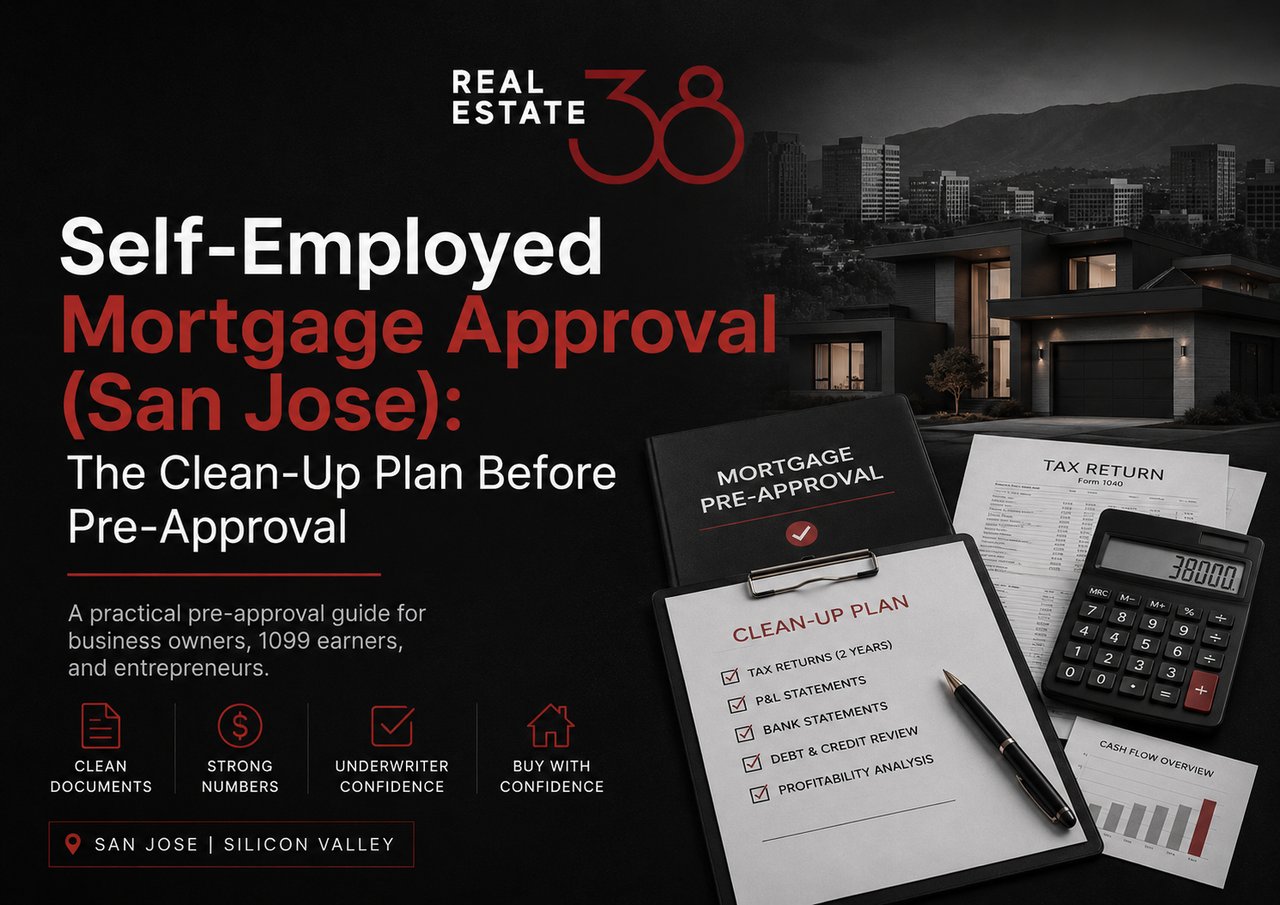
Self-employed buyers can absolutely buy a home in San Jose. I work with business owners, consultants, contractors, S-Corp owners, LLC owners, partners, and 1099 earners all the time.
The key is understanding that lenders review self-employed income differently than W-2 income.
In San Jose and Silicon Valley, where purchase prices and loan amounts are often high, a small income documentation issue can turn into a major approval problem. That is why I always want self-employed buyers to clean up the loan file before shopping, not after they find the right home.
The faster path is simple: organize the income story, get the lender to review the full picture, solve documentation questions early, and then shop with a budget that matches the actual approval.
For a bigger overview of financing options, I also recommend reviewing my San Jose Home Loan & Mortgage Guide.
Lenders want to know that your income is stable, documentable, and likely to continue.
For a W-2 employee, that may be easier to verify with pay stubs, W-2s, and employment history. For a self-employed buyer, the lender usually has to look deeper.
They may review:
This does not mean self-employed buyers are weaker buyers. It just means the file has more moving parts.
In a competitive San Jose market, those moving parts need to be organized before you write offers.
Most lenders want to see a two-year history of self-employed income.
That does not always mean every buyer needs the exact same documentation or the exact same loan program. But in general, lenders are trying to answer one question:
Can this buyer reliably afford the mortgage based on income that can be documented?
For self-employed buyers, lenders may look at:
The cleaner this file is, the easier it is for the lender to give a confident approval.
This is one of the biggest issues I see with self-employed buyers in San Jose.
A business may have strong gross revenue, strong deposits, and healthy cash flow, but the lender may not qualify you based on gross revenue. They usually care more about taxable income, adjusted net income, and income that can be supported through tax documents.
That means large tax write-offs can reduce the income a lender uses for approval.
There is a difference between:
A buyer may feel financially strong because the business is doing well, but the lender may calculate qualifying income differently.
This is why I recommend talking to a lender and CPA before the home search if you are self-employed. I am not your lender or CPA, but I do help buyers coordinate the timing so the loan strategy, tax picture, and home search do not work against each other.
A strong recent year helps, but it may not always solve the approval.
If your prior year was much lower, the lender may average the two years. If income is declining, the lender may use the lower year or ask for more explanation. If the business changed structure recently, the lender may need to understand whether the income is truly the same business income under a different entity.
For example, these situations can create extra questions:
None of these are automatic deal-breakers. But they need to be explained clearly before you are in contract.
If you are self-employed and want to buy in San Jose, I recommend starting the clean-up process 60 to 90 days before you shop.
Here is the plan I would follow.
Do not assume your actual cash flow equals your qualifying income.
Ask the lender to review your full self-employed income file and explain what number they are using for approval. You want to know:
This number affects your price range, monthly payment comfort, down payment strategy, and offer confidence.
The fastest approvals usually start with complete documentation.
Before the lender review, gather:
The goal is not just to get pre-approved. The goal is to get pre-approved in a way that will survive underwriting.
If you are planning to buy soon, talk to your CPA and lender before making major tax decisions.
Many self-employed buyers want to reduce taxable income. That can be smart for taxes, but it can also reduce mortgage qualifying income.
This is especially important in San Jose, where the difference between qualifying for one price range and another can affect the neighborhoods, home types, and competition level you are entering.
Before you shop, understand how your tax strategy affects your loan strategy.
Try not to create avoidable confusion while you are getting ready to buy.
Before or during pre-approval, be careful with:
Some changes may be necessary. The key is communication. Tell the lender before making a move that could affect underwriting.
In San Jose, a vague pre-approval can weaken your offer.
Listing agents want to know that the buyer can close. Sellers want certainty. If your income is self-employed, a stronger lender review can help reduce concerns before they come up.
When possible, I like self-employed buyers to be fully reviewed or underwritten before writing serious offers. That gives us a cleaner strategy when we are competing against W-2 buyers, cash buyers, or buyers with larger down payments.
You can also review my San Jose Home Buying Process Guide to understand how financing, offers, inspections, contingencies, and closing timelines work together.
Here is a practical checklist.
This is where the real buying strategy starts. Not at the first open house.
Self-employed buyers usually do not get delayed because they are unqualified. They get delayed because the file is unclear.
Here are common mistakes I try to help buyers avoid.
This is the biggest one.
If you wait until you find the house to solve income questions, you may be trying to fix underwriting issues while competing against buyers who are already fully prepared.
In San Jose, that can put you at a disadvantage.
A business can produce strong revenue and still show lower taxable income.
The lender is not just looking at deposits. They want to understand what income is stable, documentable, and usable for repayment.
If you plan to buy soon, your CPA and lender should both understand the goal.
A tax strategy that helps you reduce taxable income may also reduce your approved purchase price.
Declining income does not always prevent approval, but it usually requires explanation.
The lender may ask whether the decline was temporary, seasonal, industry-related, or tied to a one-time event.
Clean bank statements matter.
If business and personal funds are mixed, the lender may ask more questions. Keep documentation clean and easy to follow.
Moving from sole proprietor to LLC or S-Corp may make sense for business reasons, but it can create underwriting questions.
If you recently changed structure, be ready to show continuity of income.
Your loan approval affects more than your price range.
It affects how we search, how we write offers, how we negotiate, and how confidently we can move when the right home comes up.
For self-employed buyers in San Jose, I want to know:
A buyer looking in Willow Glen, Almaden Valley, Cambrian, Berryessa, Downtown San Jose, or Santa Teresa may face very different price points and competition. The loan strategy needs to match the market strategy.
This is why I tell buyers to start with clarity before touring homes.
If you are ready to begin the search process, my San Jose home buying page explains how we help buyers prepare, search, negotiate, and close with a clear plan.
At Real Estate 38, my role is not to replace your lender or CPA. My role is to help you connect the financing strategy to the actual San Jose housing market.
That means I help you think through:
I have seen buyers lose time because they started touring before knowing how the lender would calculate their income. I have also seen buyers win because they did the work early, cleaned up the file, and entered the market with confidence.
That preparation matters in San Jose, Silicon Valley, and the broader South Bay.
You can also learn more about my local experience on the Zaid Hanna agent page.
Yes. Self-employed buyers can qualify for a mortgage in San Jose, but they usually need stronger documentation than a standard W-2 buyer. Lenders often review tax returns, business income, profit and loss statements, bank statements, and the stability of the business.
Many lenders prefer a two-year history of self-employed income. Some loan programs may allow flexibility depending on the file, but two years is a common standard. The lender will also look at whether the income is stable, increasing, or declining.
They can. Tax write-offs may reduce the income that appears on your tax returns, and lenders often use taxable or adjusted net income to calculate buying power. That is why self-employed buyers should speak with a lender and CPA before shopping for a San Jose home.
Self-employed buyers may need personal tax returns, business tax returns, K-1s, 1099s, W-2s from an S-Corp, year-to-date profit and loss statement, balance sheet, business bank statements, CPA contact information, and business license documents if relevant.
For many self-employed buyers, yes. A fully reviewed or underwritten approval can make your offer stronger and reduce surprises later. In a competitive San Jose market, sellers and listing agents want confidence that the buyer can close.
Real Estate 38 helps self-employed buyers connect the financing plan to the home search. I help you understand how your approval affects budget, neighborhoods, offer strategy, competition, and timing so you can move forward with a cleaner plan.
If you are self-employed and thinking about buying in San Jose, do not wait until you find the right home to figure out the loan file.
Start with the clean-up plan. Get the income reviewed. Understand your real buying power. Then build a search and offer strategy around a number you can trust.
If you want help preparing before you shop, reach out through my contact page.
Zaid Hanna
408-515-1613
www.re38.com
Stay up to date on the latest real estate trends.

July 22, 2026

July 18, 2026

July 14, 2026

July 6, 2026
July 2, 2026

June 29, 2026
You’ve got questions, and we can’t wait to answer them.