What Is Mello-Roos Tax and How Does It Work in San Jose?
Home Seller
Home Seller
By Zaid Hanna, Broker, Real Estate 38 · CA DRE #01421581 · Published October 27, 2026
Mello-Roos is a special tax that some San Jose homes carry on top of the standard 1 percent property tax rate. Cities and other public agencies create these taxes, through what's called a Community Facilities District, to pay for infrastructure or ongoing upkeep in newer developments, the kind of cost an older, already-built block of the city never had to cover. If you're shopping in a newer San Jose community, from a planned development near downtown to an infill project along a major corridor, you need to know whether the home carries one before you write an offer. It changes your real monthly cost, even when it doesn't show up in the list price.
Mello-Roos is the common name for special taxes authorized under California's Mello-Roos Community Facilities Act of 1982. A city, school district, or other public agency forms a Community Facilities District, usually called a CFD, draws a boundary around the parcels that benefit, and levies an annual special tax inside that boundary. The California State Treasurer's office, which tracks these districts statewide, describes the Act as a financing tool that lets a CFD issue bonds repaid by the special tax. Not every CFD actually borrows money, though. Some exist purely to fund ongoing maintenance, which matters later when we talk about how long the tax lasts.
Your base property tax is an ad valorem tax, meaning it's calculated from your home's assessed value under Proposition 13, roughly 1 percent of that value each year. Mello-Roos isn't tied to your home's value at all. It's a flat or formula-based charge per unit, per square foot, or per acre, set by the district that created it, and it shows up as its own line item rather than folding into the 1 percent rate.
Santa Clara County's own property tax reporting shows how this plays out at scale. In its report covering fiscal year 2020 to 2021, the county listed roughly 591 million dollars in total special charges and assessments, which includes CFDs, against about 5.55 billion dollars collected from the 1 percent levy that year. Mello-Roos is a real add-on where it applies, but countywide, it's a small slice of the total tax base. That's exactly why it's easy to miss if nobody points it out to you.
Mostly newer, planned developments built after 1982, when the law took effect, since an older neighborhood had no CFD to annex into. Two confirmed San Jose districts show how differently these can look.
Communications Hill (City of San Jose CFD No. 8). This district funds maintenance of the Communications Hill Specific Plan area's public improvements, things like landscaping, trails, stairways, street lighting, and open space, not new construction. The city's own CFD No. 8 report states that the district cannot issue bonded debt. When the city formed it, the maximum residential rate was 667 dollars per unit, a figure that's designed to rise each year with the regional consumer price index.
Capitol Expressway and Evergreen Place (City of San Jose CFD No. 17). This smaller district covers about 54 developed acres near East Capitol Expressway and funds similar upkeep: median and roundabout landscaping, decorative crosswalks, tree care, and graffiti removal. Per the city's CFD No. 17 report, the maximum residential rate was 396.64 dollars per unit when it was established.
Both of those figures are starting points from each district's formation, not a current 2026 bill. If you're considering a newer build or a planned community anywhere in San Jose, ask the specific question for that specific property rather than assuming an older part of town's rules apply to it.
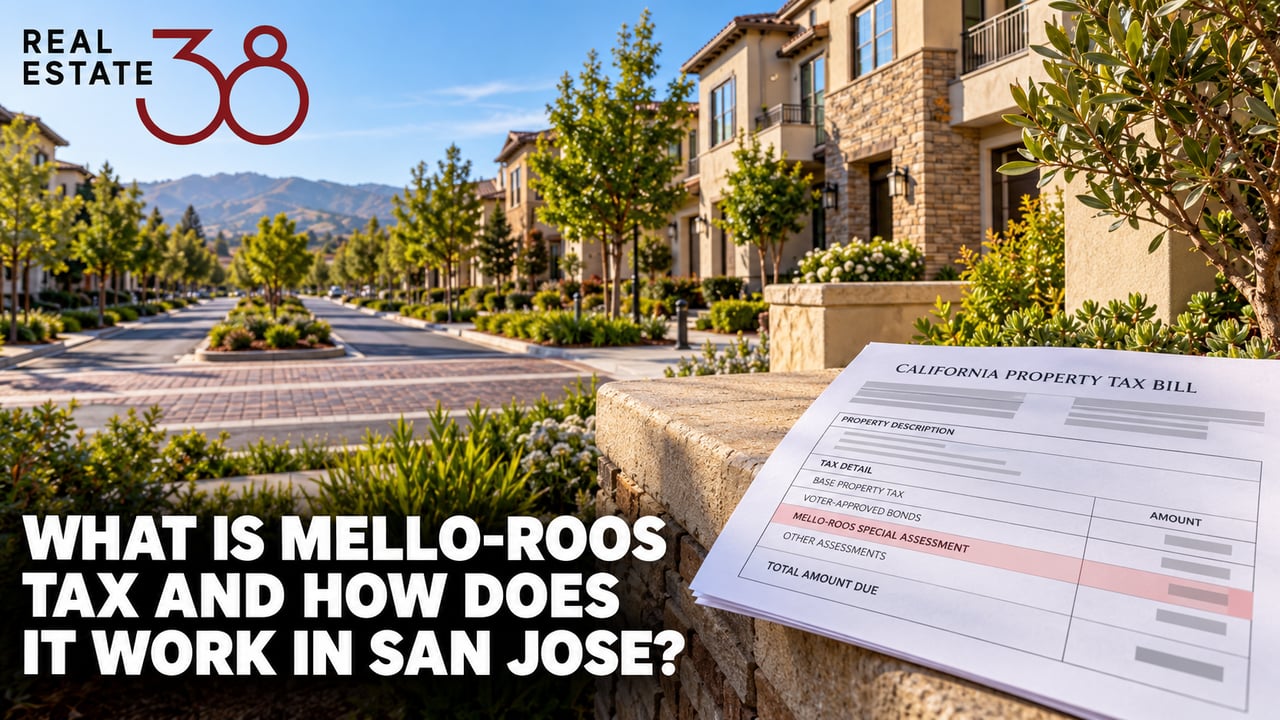
Start with the seller's current property tax bill. Mello-Roos and other special charges appear as their own line items, separate from the 1 percent general levy, often under a heading like direct levies or special assessments, and the CFD's name is usually printed right there. From there, I'd check a few more places before writing an offer:
Ask for the statutory Notice of Special Tax. California law gives sellers a specific disclosure duty here, which I cover in the next section. Pull the preliminary title report once you're in contract, since special assessments and tax liens are exactly the kind of item that report is built to surface. If you're buying new construction, the builder's purchase documents should disclose any CFD directly, which is worth comparing against what I've written about new construction costs in San Jose. And for a condo or townhome in a planned community, the same document package you'd use to review HOA obligations is a good place to also confirm whether a CFD applies, something I walk through in my HOA document review guide.
California Civil Code Section 1102.6b requires the seller to make a good faith effort to get a disclosure notice from the agency that levies the Mello-Roos tax, then deliver that notice to the buyer. If the seller instead uses a notice from a private source, state law says it has to include specific facts: the agency's name, the current year's tax, the maximum tax the district can levy, the percentage by which the tax is allowed to increase each year, the date the tax is set to stop being levied, and a contact number when one is available.
The statute doesn't set a hard deadline for when this notice has to arrive, only that it has to be delivered. But once it's in your hands, the seller and their agent generally don't owe you more explanation beyond it. If you're the one selling a home that carries a CFD, build this into your disclosure timeline early rather than scrambling for it once you're in escrow. My San Jose contracts and disclosures guide covers the rest of what sellers are required to hand over at the same time.
It depends entirely on what the district was created to do. A bond-funded CFD keeps levying its special tax until the underlying bonds are paid off, which the state treasurer's office describes as continuing "until the bonds have been retired." A maintenance-only district, like Communications Hill's CFD No. 8, which can't issue debt in the first place, can keep going for as long as the city needs it to fund that upkeep. That expiration date, when the district has one, is actually one of the facts state law requires in the disclosure notice above, so don't settle for a vague answer. Ask for the number.
Sometimes, and the distinction matters. The IRS's guidance for homeowners draws a clear line: you generally can't deduct local benefit assessments that raise your property's value, things like building new streets, sidewalks, or water systems, because those amounts get added to your home's basis instead. You can deduct the portion of an assessment that pays for maintenance, repair, or interest. A landscaping and lighting district like Communications Hill's CFD leans toward that deductible side, while a bond-funded district built to finance new infrastructure typically doesn't. If one tax bill mixes both kinds of charges, you need documentation showing exactly how much falls into each category to claim anything at all. I'm not a tax advisor, so run your specific bill past your CPA before you file.
Yes, and lenders account for it correctly even when buyers don't. Underwriters build your full expected property tax bill, Mello-Roos included, into your housing expense ratio when they calculate what you qualify for. Two homes priced identically can carry noticeably different real monthly costs once you add a CFD into one of them. That's exactly why I ask about special taxes on every newer-construction showing, before a buyer falls in love with a number that isn't the full number.
No. An HOA fee is a private contract between you and a homeowners association, paying for things like a shared pool, common-area landscaping, or building insurance. Mello-Roos is a government tax, authorized by state law and levied by a public agency through your county property tax bill. You can have one, both, or neither on the same property, and they're reported and enforced through completely different systems.
It can, but not on a fixed schedule that applies to every district. A bond-funded CFD stops once its bonds are fully repaid. A maintenance-only CFD, like the two San Jose examples above, continues as long as the city or agency keeps providing that service, which can run for decades. The specific sunset date, when one exists, is required information in the seller's disclosure notice, so ask for it directly rather than guessing.
Some bond-funded districts allow a property owner to request a payoff amount and retire their share of the obligation in one lump sum, similar to paying off a loan ahead of schedule. Whether that option exists, and what it costs, depends entirely on the individual CFD's rules. The agency that administers the district, which the disclosure notice should name, is who can give you that figure.
Not automatically. Plenty of desirable, newer San Jose communities carry one, and buyers who understand the cost simply factor it into their monthly budget the way they would an HOA fee. What actually hurts resale is a buyer discovering a sizable special tax for the first time late in their own escrow, after they've anchored on a different monthly number. Disclosing it clearly and early protects your sale, not just theirs.
It varies by district, since each CFD sets its own rate based on what it was created to fund. The two confirmed San Jose districts cited above started between 400 and 670 dollars per unit annually when formed, and both escalate over time. Your actual number is printed on the current property tax bill. Never assume one example applies to a different property.
San Jose's Mello-Roos picture is genuinely a block-by-block question, not a citywide rule, which is exactly where having someone pull the real documents for a specific address pays off. As part of Real Estate 38, recognized as part of the #1 real estate group in San Jose by sold units, based on MLS and RealTrends data from 2018 to 2026, I help both buyers and sellers get a straight answer on what a property's tax bill actually includes before any offer gets written or any disclosure goes out. If you're weighing a newer San Jose home and want me to check whether it sits inside a CFD, send me the address.
Zaid Hanna
408-515-1613
www.re38.com
Stay up to date on the latest real estate trends.

November 20, 2026

November 18, 2026

November 16, 2026

November 13, 2026
November 11, 2026

November 9, 2026
You’ve got questions, and we can’t wait to answer them.