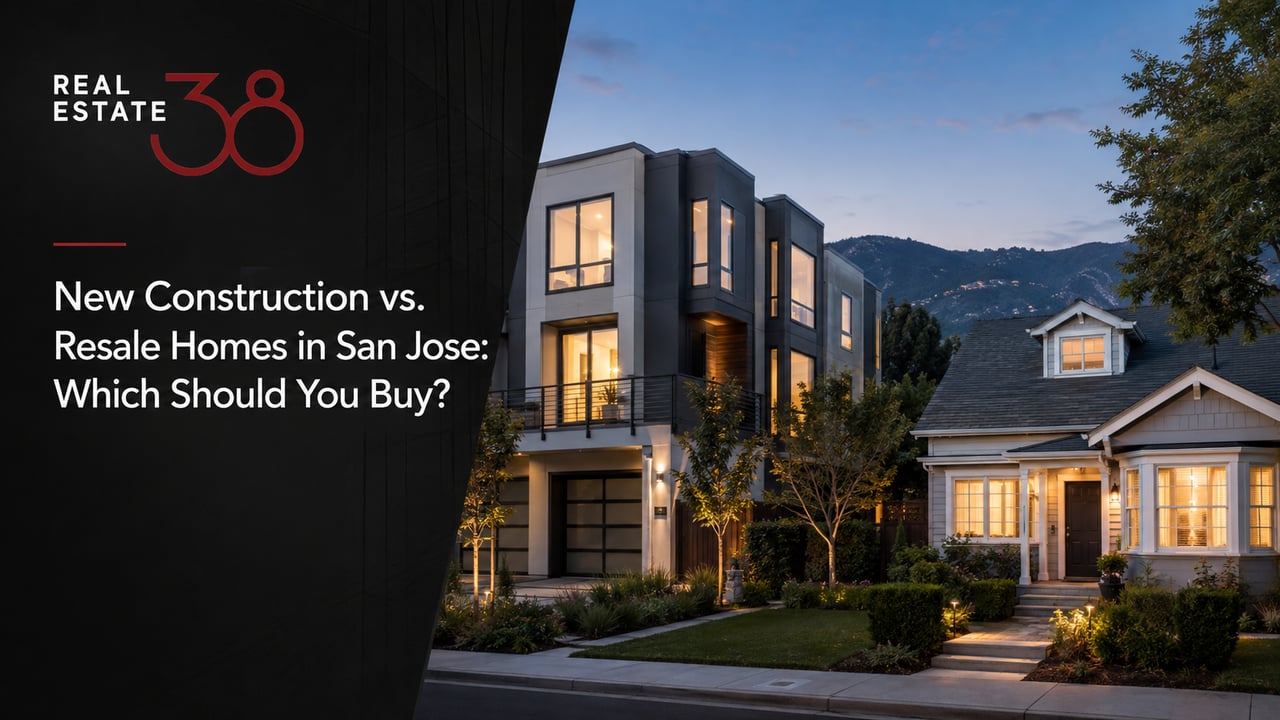
New Construction vs. Resale Homes in San Jose: Which Should You Buy?
Home Buyer
Home Buyer
Neither new construction nor a resale home is universally better for every San Jose buyer. New construction may offer current systems, modern layouts, customization, and fewer near-term repairs, but the advertised base price can exclude major ownership costs. Resale homes may offer more locations, established surroundings, and a faster closing, but condition and future repairs require careful investigation. The right choice is the specific property that best balances complete cost, location, condition, timeline, financing certainty, flexibility, and your expected holding period.
Compare actual homes, not the labels “new” and “resale” in the abstract.
One buyer may be deciding between a newly built townhome near a workable commute and an older detached home that requires repairs. Another may be comparing a completed builder inventory condo with a recently renovated resale condo in the same area. The stronger choice can change from one property to the next.
For each home, I recommend evaluating:
San Jose new construction can include condominiums, townhomes, planned developments, and detached homes. If you are still deciding among ownership structures, review my guide to San Jose condos, townhomes, and single-family homes before treating “new construction” as a property type of its own.
New construction describes several different buying situations:
The construction stage can affect deposit requirements, selection options, inspection access, financing, appraisal, rate-lock timing, available incentives, and move-in certainty. “New construction” does not mean custom construction, and a model home does not establish the exact inclusions, view, noise exposure, lot condition, or finish level of another unit.
A resale home has previously been owned or occupied. That definition does not tell you whether the home is two years old or several decades old, carefully maintained or neglected, original or extensively renovated.
A recently built resale may differ very little in age from a builder’s completed inventory home. An older San Jose property may have permitted updates to its roof, foundation, electrical system, plumbing, HVAC, layout, or energy features. Another may retain original systems or contain work with incomplete permit history.
I do not assume that every resale home is outdated or requires major repairs. I evaluate the actual condition, disclosures, inspection findings, insurance questions, permits, renovation history, and remaining life of major systems.
Depending on the property, permit date, design, and construction stage, new construction may offer:
Those possibilities must be balanced against the complete transaction:
New does not automatically mean better built, easier to insure, less expensive to own, or stronger for resale. Each conclusion needs property-specific evidence.
Resale inventory may offer:
The tradeoffs may include:
San José provides an official property and permit-status search, but a permit record does not replace inspections or prove that every improvement was completed exactly as represented.
Never compare a builder’s advertised base price directly with a resale home’s list price. Neither number necessarily equals the price you will pay or the cost you will carry.
Build a complete cash-to-close, monthly-cost, and reserve analysis for each actual property. The San Jose home-buying process guide explains how financing, due diligence, contingencies, appraisal, escrow, and closing fit together.
A new home with a higher price may require fewer near-term repairs but still involve substantial upgrades, taxes, HOA dues, and completion costs. A lower-priced resale may need major work, but a well-maintained resale property can require less immediate spending than a buyer assumes.
They can be, but only when the complete financing and purchase structure is stronger.
Builder incentives may include:
The largest headline incentive is not automatically the best value. Compare:
When financing is involved, request official Loan Estimates built around comparable loan terms. The Consumer Financial Protection Bureau explains how to review and compare Loan Estimates from multiple lenders.
I do not assume that a builder’s preferred lender is better or worse than an outside lender. The best choice depends on the complete loan, execution risk, service, timing, and net transaction cost.
A builder may use a purchase agreement drafted specifically for the company, project, phase, and property. It may allocate rights, deadlines, and risks differently from a standard resale transaction.
Before signing, investigate:
Do not rely on a verbal statement if the issue matters to your decision. Ask where it appears in the contract or project documents.
I can help identify questions and coordinate the real estate review, but I do not interpret legal language as an attorney. Have legal questions reviewed by an appropriate qualified professional before signing, releasing a deposit, or waiving a right. My San Jose contracts, disclosures, and property-tax guide provides additional context for California buyers.
You are not required to choose independent representation in every transaction, but you should understand who represents whom before relying on advice in a builder sales office.
The builder’s sales representative generally works for the builder or seller unless a different agency relationship is formally disclosed and established. That representative can provide valuable project information, but the seller’s business goals are not the same as an independent buyer evaluation.
Clarify representation, services, compensation, and registration procedures before your first builder visit or online registration. Builder policies vary, and a builder may not pay the buyer agent’s compensation. California also has written buyer-representation requirements, summarized in the California DRE buyer-representation advisory.
With independent representation, I can help a buyer evaluate:
The services, compensation, and builder registration rules should be clear before touring or signing documents.
Yes. A new home should still be independently evaluated.
Possible inspection stages, when the builder, contract, construction stage, and safety rules permit them, include:
Not every builder permits every inspection stage. Access may be limited by construction sequencing, site-control rules, insurance, or safety requirements, so negotiate and document inspection access early.
Municipal inspections and occupancy approvals relate to applicable code and public approval processes. They do not necessarily replace a buyer’s independent review of visible workmanship, installation, operation, and defects. Use appropriately licensed inspectors or specialists for the issue being evaluated.
A builder warranty is useful only to the extent of its written coverage, responsible party, exclusions, deadlines, and claim process.
Review:
A warranty is not complete protection. It does not eliminate the need for inspections, detailed documentation, routine maintenance, follow-up, or repair reserves.
A subdivision public report is an important disclosure document for many new California subdivisions and common-interest developments.
The California Department of Real Estate public-report guidance explains that a subdivider must provide the applicable report to a prospective buyer before that buyer becomes obligated to purchase a lot or unit. The report and related documents may address:
Read the actual report for the specific phase and property. It is not a builder endorsement, and it does not replace inspection, title, HOA, financing, insurance, or legal review.
Yes. A new condominium, townhome, planned development, or detached home may have an HOA, special taxes, or both. Not every development does.
Verify:
Mello-Roos and other special taxes are property-specific. Never estimate them from a nearby community or assume that every San Jose new home carries the same obligation.
A change in ownership can lead to reassessment and a supplemental property-tax bill for either new construction or resale. Completion of new construction can also create assessment consequences based on the property and timing.
The Santa Clara County Assessor’s supplemental-assessment guidance explains that a supplemental bill is separate from the regular bill and is based on the difference between the prior assessed value and the new reappraisal for the applicable portion of the fiscal year. Buyers should not assume that escrow or a lender impound account will automatically cover it.
Keep these charges separate in your analysis:
Do not use a universal percentage or a neighboring property’s bill as your final estimate. Confirm the parcel-specific information with the county, title and escrow professionals, and a qualified tax adviser.
California energy requirements depend on the permit-application date, building type, code cycle, design, compliance path, and applicable exceptions. The California Energy Commission’s 2025 Energy Code guidance states that the 2025 standards apply to buildings with permit applications submitted on or after January 1, 2026.
Do not assume that every new home has the same equipment or ownership terms. Verify:
Energy-code compliance does not guarantee a specific utility bill. Actual costs depend on the home, equipment, rates, weather, maintenance, and how the occupants use energy.
Not automatically. New construction inventory exists only in certain locations and phases. A new home may be farther from your actual office, while a resale home may offer a shorter route. For a different office or property, the reverse may be true.
Compare:
Use my San Jose and Silicon Valley commute guide to test exact routes without letting a city or neighborhood label make the decision for you.
Technology professionals are not one buyer type. Some prioritize a dedicated office, some travel frequently, and others care more about outdoor space, a short commute, or low maintenance.
For each property, verify:
A new layout may support one work style, while a resale home’s location, lot, room configuration, or completed improvements may support another. Test the actual home rather than assuming newer means more compatible with technology work.
There is no universal construction or escrow timeline.
Match each timeline against:
If the dates are important, identify the contract remedies, extension costs, deposit risk, and backup housing plan before committing.
The financing structure can make two similarly priced homes perform very differently.
Important issues include:
Confirm project eligibility, appraisal procedures, reserve requirements, rate-lock terms, and completion conditions with the lender. Review the San Jose home loan and mortgage guide before treating an incentive as a financing solution. No agent, builder, or lender should guarantee approval before the required underwriting and property review are complete.
Future resale depends on the exact property and the market that exists when you sell. Neither new construction nor resale automatically creates more appreciation or equity.
Evaluate:
A short expected holding period makes transaction costs, market risk, and resale flexibility more important. A longer holding period gives you more time, but it also increases the importance of maintenance, HOA stability, location, and whether the home can adapt to changing needs.
Every property requires due diligence. The exact documents vary by project, ownership structure, transaction, and property history.
Documents are evidence, not a substitute for analysis. Follow up on inconsistencies, missing items, unclear responsibilities, and property-specific risks before removing contingencies or allowing a deposit to become nonrefundable.
Create a scorecard for the actual properties. Use the same scale for both and write the evidence supporting every score.
Score:
If a cost, document, timeline, or condition has not been confirmed, mark it unverified. Do not award an optimistic score because a salesperson, seller, or buyer hopes the answer will be favorable.
I help buyers make this decision at the property level.
That means comparing current inventory, recent comparable sales, builder pricing, lot premiums, incentives, ownership structure, property condition, disclosures, public reports, HOA documents, inspection findings, financing, commute requirements, timeline, complete ownership cost, expected holding period, and future resale flexibility.
I am known as the Data Guy because I want the recommendation tied to evidence, not a generic belief that new is always better or that resale always offers more value.
Real Estate 38 can also help buyers explore San Jose neighborhood options and compare how specific homes fit the purchase plan before visiting a builder or writing an offer.
Not always. Compare the new home’s completed price, including lot premiums, options, appliances, solar, landscaping, HOA dues, taxes, assessments, closing costs, and delay exposure, with the resale home’s negotiated price, repairs, renovations, insurance, HOA obligations, and reserves.
They can be. Compare the purchase price, interest rate, APR, points, fees, closing costs, monthly payment, cash after closing, appraisal risk, rate-lock period, and conditions attached to the incentive. The largest advertised credit is not automatically the best offer.
Independent representation is a buyer choice, but understand that the builder’s sales representative generally represents the builder or seller. Clarify agency, services, compensation, and builder registration rules before the first visit or registration.
Often, yes, subject to the contract, builder policy, construction stage, access, and safety rules. Ask about pre-drywall, progress, final, and reinspection opportunities before signing. Municipal inspections do not necessarily replace an independent buyer inspection.
It is a California DRE disclosure document for many new subdivisions and common-interest developments. It may address restrictions, HOA costs, common areas, utilities, phasing, assessments, and other material facts. Review the applicable report before becoming obligated to purchase.
Yes. New condominiums, townhomes, planned developments, and some detached communities may have an HOA. Verify dues, maintenance responsibilities, reserves, insurance, restrictions, assessments, builder control, and future phases.
No. Mello-Roos and other special taxes are property-specific. Verify the parcel, Community Facilities District documents, tax information, calculation method, and expected duration instead of relying on a nearby development.
A change in ownership can trigger reassessment, and completed new construction can have additional assessment consequences. Distinguish regular taxes, supplemental bills, HOA assessments, and Mello-Roos or other special taxes. Obtain parcel-specific guidance from the county and qualified tax professionals.
No. Coverage, duration, exclusions, maintenance duties, claim deadlines, dispute procedures, and transferability vary. A warranty does not replace inspections, documentation, maintenance, follow-up, or repair reserves.
Yes. A delayed completion can extend beyond a rate-lock period or create extension costs, new underwriting requirements, or a need to revise financing. Confirm the lender’s lock, extension, expiration, and requalification rules before committing.
No. A quick move-in home is usually complete or near completion, often with many selections already made. A custom home is designed or built around a buyer’s specifications under a different construction and contract process.
Compare door-to-door travel, required office days, total weekly transportation cost, complete ownership cost, condition, space, maintenance, employer flexibility, partner commute, and expected holding period. Neither option is universally better.
The best San Jose new construction versus resale decision comes from comparing two real properties with complete numbers, verified documents, realistic timelines, and an honest view of your holding period.
If you are considering a builder community, quick move-in home, or resale property, contact me before your first builder registration or before submitting an offer. I can prepare a property-specific new-construction versus resale comparison and help you identify what remains unverified. You can also review our San Jose home-buying services as you prepare.
Zaid Hanna
Real Estate 38
www.re38.com
Stay up to date on the latest real estate trends.

September 11, 2026

September 9, 2026

September 5, 2026
September 1, 2026

August 28, 2026

August 24, 2026
You’ve got questions, and we can’t wait to answer them.