Buying a San Jose Home With ADU Potential: How to Verify It Before Paying a Premium
Home Buyer
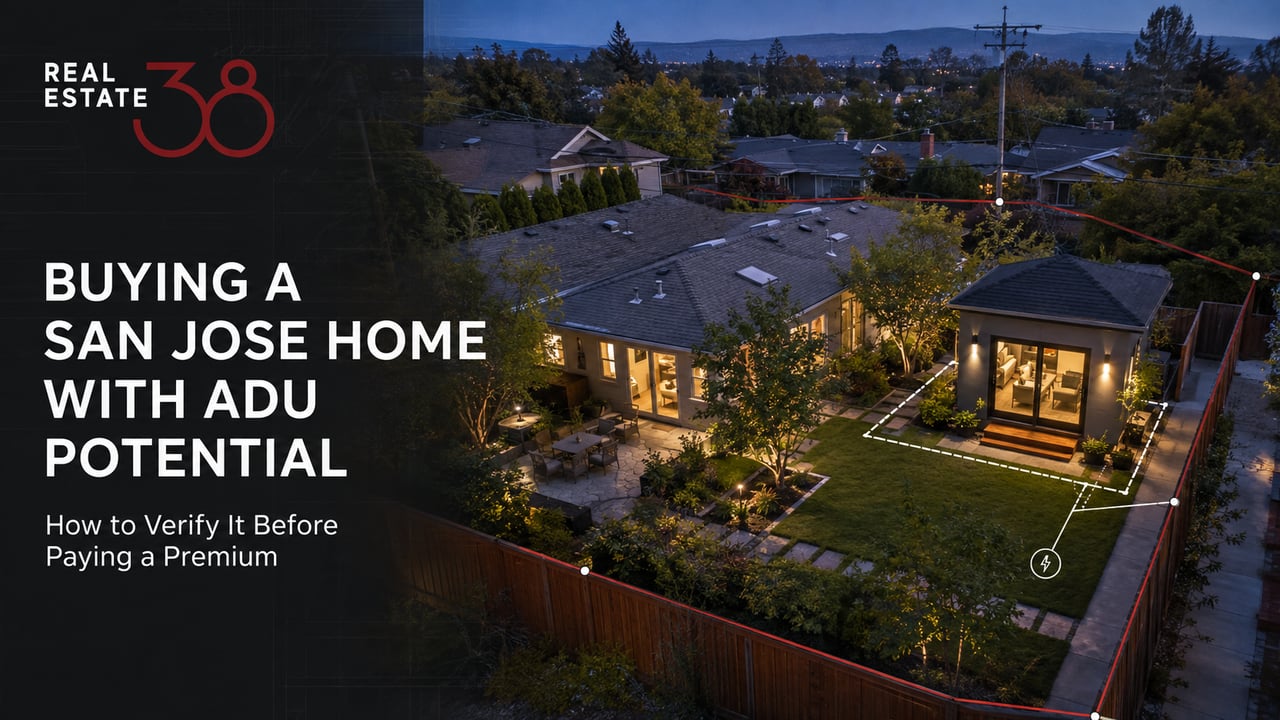
Home Buyer
Before paying a premium for a San Jose home with ADU potential, verify the exact parcel, proposed unit type, current zoning rules, legal unit count, permits, boundaries, easements, usable area, hazards, fire access, utilities, sewer, electrical capacity, HOA restrictions, insurance, taxes, financing, construction estimates, and reserves. A large backyard, detached garage, listing statement, contractor opinion, or preapproved plan is only a starting point. Every unresolved, outdated, conflicting, or unsupported fact should be labeled unverified.
This investigation must be property-specific. A concept that could work on one San Jose lot may not work on the next lot, even when the homes appear similar.
The broader San Jose home-buying process guide explains how property investigations connect with disclosures, inspections, financing, appraisal, and offer decisions.
“ADU potential” is not one verified condition. It can describe several very different stages:
These stages should not receive the same weight when you evaluate a home or decide what to offer.
An issued permit is not the same as a finaled permit. A conceptual plan is not an issued permit. A City preapproved standard plan is not approval for the subject property. A listing statement is not a feasibility study.
I recommend recording exactly which stage has been reached and labeling everything beyond that stage unverified.
Start by defining what you want to create. The proposed project changes the records, site conditions, professional review, utility work, budget, and permit questions.
Possible concepts include:
Do not treat these options as interchangeable. Current eligibility, unit count, dimensions, parking, access, utilities, deed restrictions, and other standards depend on the exact property and project type.
The March 2026 California HCD ADU Handbook provides the current state framework. San Jose buyers should also use the current City of San Jose ADU page and Universal Checklist for local, property-specific review.
Build one file containing the records that describe the property legally, physically, and operationally.
Collect:
Use SJPermits property search to begin reviewing available City records. Online records have limitations, so the absence of a permit in a search result is not conclusive proof that work was illegal.
Compare every source. A listing, assessor record, disclosure, floor plan, utility bill, or physical observation may provide useful evidence, but no single source necessarily answers every legal, permit, boundary, utility, or occupancy question.
Create a numbered worksheet for the exact property. Give each item one of three statuses: supported, requires professional confirmation, or unverified.
Do not mark an item supported because someone said it “should be fine.” Record the document, professional, agency, date, assumptions, and scope supporting the conclusion.
Compare what physically exists with the available permits, approved plans, inspections, addresses, utility records, disclosures, and final status.
A detached room, kitchenette, separate entrance, bathroom, converted garage, workshop, guest space, pool house, or bonus room is not automatically a legal ADU.
Determine whether the records support one of these classifications:
A general visual inspection can help identify physical concerns, but it does not establish legal boundaries, zoning compliance, ADU approval, utility capacity, easement location, fire access, construction cost, or future permit issuance. Use the San Jose home-inspection guide for the broader property-condition framework.
Confirm the address, parcel number, jurisdiction, zoning, property type, lot configuration, and legal unit count from multiple sources.
Relevant sources may include:
Assessor information may help describe the property for assessment purposes, but it does not independently establish that every improvement was permitted or approved for its current use.
City records may show applications, permits, and inspections, but the status of each record matters. “Applied,” “issued,” “inspected,” and “finaled” are different.
Not necessarily. Fences, hedges, retaining walls, patios, driveways, and landscaping may not follow recorded property lines.
If the proposed ADU depends on precise placement, collect the recorded map, preliminary title report, existing survey, and relevant easement documents. A boundary or topographic survey may be appropriate when dimensions, slopes, structures, or access are critical.
Do not measure from a fence and treat the result as a legal setback determination.
Yes. Easements, utility corridors, drainage rights, sewer easements, shared-driveway agreements, access rights, and other recorded obligations can affect placement, excavation, utility connections, construction access, or long-term use.
An easement does not automatically make an ADU impossible. Its location, language, beneficiary, purpose, and effect must be reviewed.
Collect the actual recorded document and compare it with the proposed site plan. Direct boundary and legal conclusions to qualified title, survey, escrow, and legal professionals.
These requirements can determine whether the proposed footprint works and may vary by property type, ADU type, location, existing development, and the current City and state rules.
Test the preliminary concept against:
The City’s current ADU plan review and permit process directs applicants to start with the Universal Checklist and then develop site-specific plans.
Do not apply a dimension found in an older article or generic calculator without verifying that it applies to the exact property and proposal.
Yes. Yard size alone does not establish ADU eligibility, usable building area, utility feasibility, or construction cost.
A large yard may still contain:
The proposed unit’s footprint and intended use also matter. Until those conditions are investigated, the claim remains unverified.
Depending on the property, the ADU concept may require review of:
A hazard designation does not automatically prohibit an ADU. It may introduce additional review, design, insurance, access, construction, or cost questions.
The absence of one designation also does not prove that approval will be uncomplicated.
When applicable, investigate:
Do not interpret fire code from a listing photo or site visit. The required review depends on the proposal, site, existing residence, and current City requirements.
Yes. Street trees, protected or ordinance-size trees, canopy, roots, and required landscaping can affect the proposed location and construction access.
Verify:
Landscaping can also conceal retaining walls, drainage features, utility equipment, or uncertain boundaries. Do not assume a tree can be removed until current City and professional review supports that conclusion.
An ADU concept can be physically plausible on paper but difficult to execute on the site.
Investigate:
A prefabricated or modular unit does not eliminate foundation, utility, access, drainage, permitting, or site-preparation questions.
Identify the existing sewer lateral and the proposed connection path. Depending on available records and professional recommendations, investigate:
Do not assume existing sewer and water service is adequate. Do not assume that replacement or a new service is required. Obtain project-specific review.
Panel spaces alone do not prove available electrical capacity.
The review may need to consider:
PG&E’s residential building and renovation resources explain its project application and review process. Meter, service, transformer, and upgrade requirements should be confirmed directly for the specific project.
Do not assume every ADU requires the same meter or service arrangement.
Yes. Existing equipment can affect location, electrical capacity, utility clearances, trenching, panel configuration, future loads, and possible relocation work.
Verify:
The complete solar and EV-charger buyer verification guide explains the broader ownership, permit, utility, billing, and equipment review.
No. San Jose describes its preapproved ADUs as standard, non-site-specific construction plans reviewed for applicable code compliance.
The property still needs site-specific review, which may include:
Do not treat a vendor rendering or preapproved design as a permit for the property.
No. A garage conversion may avoid some new structural work, but the existing building must still be evaluated for the proposed use.
Verify:
Do not assume an existing garage is legally or practically convertible. Obtain property-specific professional findings and estimates.
Collect every available permit, approved plan, inspection record, City letter, code record, utility document, disclosure, photograph, invoice, and construction record.
Distinguish among:
San Jose maintains AB 2533 ADU and JADU legalization information. Eligibility depends on facts such as construction timing, documentation, location, conditions, and the current program requirements.
Do not assume every unpermitted unit qualifies. A legalization pathway does not guarantee approval, limited corrections, cost, or timing.
Review the documents that establish what the buyer owns, what is common area, how utilities are controlled, and what approvals may apply.
Relevant items may include:
A yard, garage, patio, or parking space next to the home may not be owned entirely by the buyer.
Use the complete San Jose HOA-document review guide for the wider association evaluation. ADU-specific legal conclusions should be directed to qualified professionals.
Historic status, planned-development permits, subdivision restrictions, hazard areas, overlays, and nonconforming conditions may affect design, clearances, review, or required professional involvement.
Historic status does not automatically prohibit an ADU. It also should not be ignored.
Confirm the property’s status, applicable documents, reviewing agencies, and current requirements before assigning value to the concept.
Yes. Insurance questions should be investigated before purchase and again before construction.
Ask a qualified carrier or broker about:
The California Department of Insurance residential resources provide general consumer guidance. Availability, premium, renewal, and claim treatment remain property-specific.
Yes. Ask your lender and, when appropriate, the appraiser about:
Do not assume future rent will be counted for qualification. Plans, permits, estimates, or projected value do not guarantee loan approval or a higher appraisal.
New construction and changes in property configuration may create property-specific assessment questions.
The result can depend on the work completed, ownership history, property configuration, and applicable assessment rules. Review the Santa Clara County Assessor’s Proposition 13 information and direct tax conclusions to the Assessor and a qualified tax professional.
Do not rely on a generic online calculation to predict reassessment, supplemental taxes, basis, depreciation, exemptions, or tax benefits.
Separate sale is not automatic.
San Jose has an ADU condominium-conversion process with a checklist, required documentation, eligibility conditions, and a Parcel Map process.
Do not assume an existing or future ADU qualifies. Subdivision, title, HOA, tax, lending, insurance, and legal consequences require qualified review.
Do not start with a generic cost-per-square-foot estimate. Build the budget from the verified property-specific scope.
Organize the budget into:
For each written estimate, record:
Verify contractor licensing and current status through the California Contractors State License Board when a license is required.
Property-specific written estimates are more useful than online averages because they connect cost to the actual lot, design, utilities, access, and existing improvements.
Do not assign a premium until you understand what level of feasibility is supported.
Evaluate:
A finaled legal ADU, an issued permit, a professional feasibility study, and a listing statement represent different levels of evidence.
Do not assume a dollar-for-dollar premium. Do not assume unsupported potential has zero value. Use matched sales and the San Jose resale-value evaluation guide to keep the analysis evidence-based.
Use the same questions and evidence standard for both homes.
Do not declare one property better because it has the larger yard. Match the evidence first.
A material finding may justify additional investigation or a different financial decision.
Depending on the property and transaction, it may affect:
Purchase agreements, disclosures, title records, investigation rights, deadlines, and remedies are transaction-specific. Review the San Jose contracts, disclosures, and property-tax guide for the broader framework, then obtain transaction-specific advice from the appropriate real estate, title, escrow, lending, tax, and legal professionals.
None of these statements is reliable by itself:
There are no universal deal-breakers, but reconsideration may be appropriate when:
The correct decision depends on the exact property, proposed project, documentation, professional findings, intended use, finances, timeline, and risk tolerance.
My role is to help buyers replace assumptions with organized, property-specific evidence.
At Real Estate 38, I can help you:
That is where my “Data Guy” approach matters. I do not perform zoning, legal, architectural, engineering, surveying, utility, construction, insurance, tax, lending, title, or appraisal evaluations. I help buyers organize the right information and coordinate the appropriate experts before making a major purchase decision.
You can review our San Jose home-buying services to see how Real Estate 38 supports buyers throughout the process.
Confirm the parcel, jurisdiction, zoning, property type, legal unit count, proposed ADU type, current rules, boundaries, easements, site conditions, utilities, hazards, and professional findings. Until the property-specific review supports the concept, ADU eligibility is unverified.
No. Yard size does not establish legal boundaries, setbacks, usable area, easements, fire access, utility feasibility, sewer routing, tree clearance, drainage, construction access, or approval.
An ADU is an independent dwelling unit. A JADU is a separate category created within qualifying single-family residential space and is subject to its own current requirements. Verify the current City and state rules for the specific proposal.
It may be possible for some properties and project types, but the answer depends on current state and City rules, property type, existing units, and the exact proposal. Do not assume both are allowed without property-specific review.
Start with the address and parcel number, then review current City planning information and the ADU Universal Checklist. Confirm the zoning and its effect with the City or a qualified professional when the project depends on that conclusion.
Search the property through SJPermits, then compare applications, issued permits, approved plans, inspections, expiration information, and final status. The absence of an online record is not conclusive by itself.
No. A listing statement is marketing information. Verify the claim using property records, current requirements, a site-specific concept, professional review, utilities, access, and written estimates.
Not necessarily. Use recorded maps, title information, an existing survey, or qualified surveyor review when ADU placement depends on precise boundaries.
It can affect placement, access, excavation, or utilities, but not every easement prohibits development. Review the recorded document, location, purpose, and professional interpretation.
The answer depends on current law, property type, proposed ADU type, existing structures, and site conditions. Use the current City Universal Checklist and property-specific professional review.
Maximum size depends on current City and state rules, property type, project type, existing development, and the proposed design. Do not rely on a generic maximum without confirming that it applies to the parcel.
Applicable height standards depend on the current rules and project characteristics. Verify the proposed height for the exact site and ADU type.
Parking treatment depends on current law, project type, property location, conversion status, and other facts. Confirm the current property-specific requirement before designing or valuing the project.
Possibly, but the garage’s permit history, approved use, structure, foundation, dimensions, fire separation, utilities, access, and current condition require verification.
No. Existing structural deficiencies, utility work, demolition, fire requirements, and unpermitted alterations can materially change the scope. Compare current property-specific estimates.
No. It is a standard, non-site-specific plan. The property still requires site documentation, eligibility review, clearances, utilities, foundation, and permit approval.
No. The plan must be tested against the subject property’s size, configuration, setbacks, utilities, hazards, access, and other current requirements.
Verify the access route, distance from the street, gates, driveway, addressing, sprinklers, hydrant or water-supply questions, WUI status, building separation, and any required Fire Department review.
Yes. These conditions may introduce additional review, design, insurance, access, or construction requirements. They do not automatically prove that an ADU is allowed or prohibited.
Yes. Protected trees, street trees, canopies, roots, removal requirements, and construction access can affect placement and cost. Obtain current City and professional review when relevant.
Verify the lateral location and condition information, connection route, slope, cleanouts, easements, water service, meters, trenching, and applicable City or provider review.
Metering policies and project requirements should be confirmed directly with PG&E for the exact proposal. Do not assume one universal arrangement.
No. Available breaker spaces do not replace a load calculation, service review, equipment evaluation, or utility confirmation.
Yes. Solar ownership, equipment location, meter configuration, service capacity, roof access, trenching, and future loads may affect the plan.
Collect City records, plans, inspections, code information, disclosures, utility records, and professional findings. Evaluate legalization eligibility and required work without assuming approval.
Some units may qualify under the current City process, but eligibility depends on construction timing, evidence, location, conditions, and program requirements. Legalization is not guaranteed.
The answer depends on current law, governing documents, ownership boundaries, common areas, utilities, access, and the proposed project. Obtain qualified HOA and legal review rather than assuming the outcome.
Historic status does not automatically answer the question. Confirm the designation, applicable review, design requirements, clearances, and professional recommendations.
It may affect underwriting, coverage, liability, replacement cost, builder’s risk, unit count, rental-use treatment, and premiums. Obtain property-specific insurance guidance.
Possibly in some loan scenarios, but it is not automatic. Ask the buyer’s lender how legal status, plans, appraisal treatment, income documentation, reserves, and property eligibility apply.
New construction or a change in property configuration may create assessment questions. Ask the Santa Clara County Assessor and a qualified tax professional for property-specific guidance.
San Jose has a condominium-conversion process with specific conditions and documentation. Separate sale is not automatic and requires title, subdivision, HOA, lending, tax, and legal review.
Only after determining what level of feasibility is supported by records, site review, professional findings, estimates, comparable sales, and available reserves. Do not pay a premium based solely on marketing language.
There is no reliable property-independent answer. Cost depends on the site, design, utilities, structure, access, hazards, professional services, permit scope, restoration, insurance, and contingency. Obtain current written estimates.
Timing depends on application completeness, project type, agency review, corrections, utilities, site work, contractor availability, inspections, and unforeseen conditions. Do not rely on a generic promise.
Reconsider when material questions about legal status, boundaries, easements, buildable area, hazards, utilities, insurance, financing, cost, or reserves remain unresolved and the purchase price depends on the claim.
I can help define the proposed use, organize records, identify missing information, coordinate appropriate professional review, compare written estimates and sales, and build an evidence-based offer strategy.
A San Jose property does not become “ADU-ready” because it has a large backyard, detached garage, attractive rendering, nearby ADU, or optimistic listing description.
Before you pay for future potential, identify what is documented, what has been professionally reviewed, what the City or utility still needs to evaluate, what the complete project may require, and what remains unverified.
If you are considering a specific home, I can help you request a property-specific ADU feasibility review before you submit an offer or remove applicable investigation protections.
Zaid Hanna
Real Estate 38
www.re38.com
Stay up to date on the latest real estate trends.

September 21, 2026

September 18, 2026
September 17, 2026
September 14, 2026

September 11, 2026

September 9, 2026
You’ve got questions, and we can’t wait to answer them.