Buying a San Jose Home With Solar or an EV Charger: What to Verify Before You Offer
Home Buyer
Home Buyer
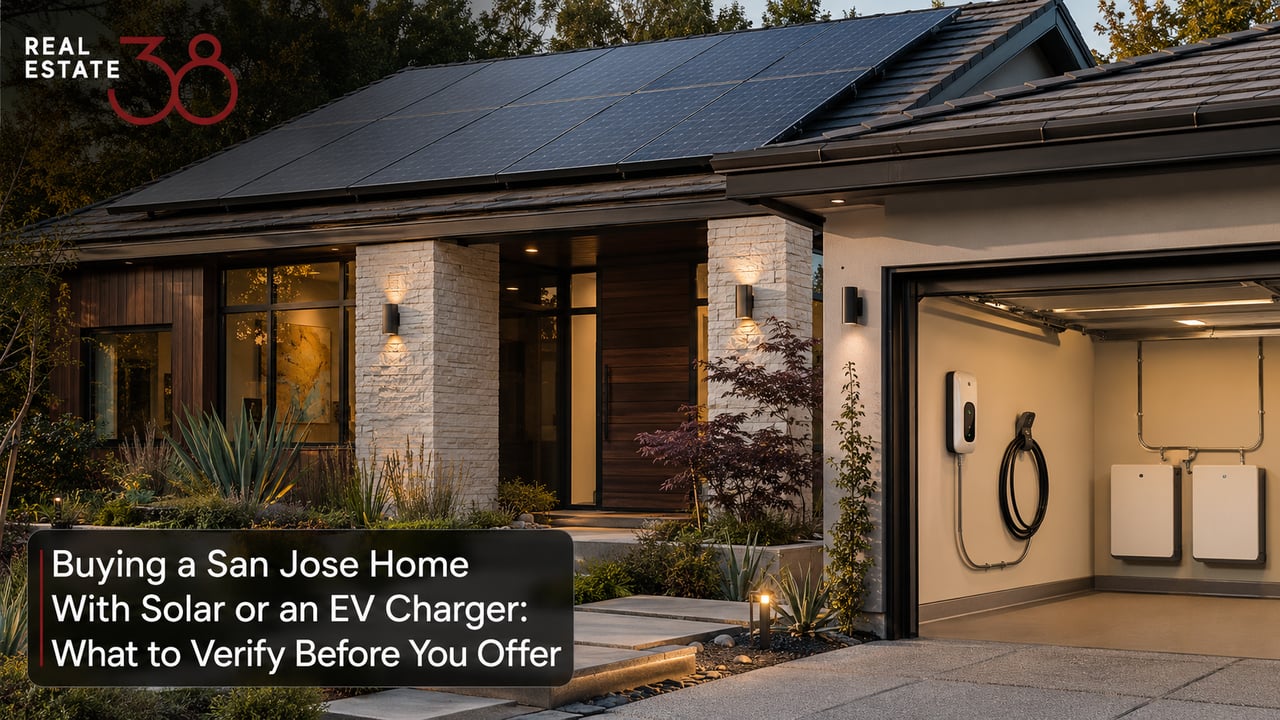
Before buying a San Jose home with solar panels or an EV charger, verify what equipment is present and included, who owns it, every related contract, transfer or payoff requirement, permit and final status, utility Permission to Operate, billing treatment, production records, roof condition, warranties, battery configuration, charger compatibility, electrical capacity, HOA rights, insurance, and property-specific reserves. Visible equipment, listing language, one utility bill, or a seller statement is not enough. Label every missing, outdated, conflicting, or unclear item unverified.
Solar panels, a battery, or an EV charger can fit one buyer's plans and create unanswered questions for another. The conclusion depends on the actual property, equipment, ownership structure, documents, utility account, roof, electrical system, intended vehicle, planned loads, insurance, and the buyer's financial reserves.
This review begins after the listing, disclosures, or tour suggests that solar or charging equipment may be present. It belongs inside the broader San Jose home-buying process, but it requires a more specialized investigation than simply noticing panels on the roof or a charger on the garage wall.
Start by building a physical inventory. Record what you can identify without opening, disconnecting, resetting, or servicing equipment yourself:
Then compare the physical inventory with the purchase agreement, seller disclosures, invoices, plans, permits, utility records, warranties, and provider documents. Equipment can be physically attached to a home without the seller necessarily owning it or having the unrestricted right to transfer it. Portable charging equipment or adapters may also be treated differently from installed equipment. Do not make a fixture or personal-property conclusion without reviewing the transaction-specific documents with the appropriate professionals.
The California Energy Commission Solar Equipment Lists can help identify listed equipment and certification information. A product's presence on a state list does not prove that the property-specific installation is correct, operational, warrantied, or currently eligible for any particular program.
Similar-looking solar systems can create very different buyer obligations. The California Public Utilities Commission Solar Consumer Protection Guide distinguishes a purchased system from a lease and a power purchase agreement, but the actual contract controls the property-specific questions.
Possible arrangements include:
The California Contractors State License Board Solar Smart resource also explains why financing, lease, and contract terms can affect a later home sale. Never assume that every loan, lease, PPA, prepaid arrangement, assessment, or service agreement has the same transfer result.
Ask for a complete document package, then compare records rather than reviewing each item in isolation:
Missing documents matter. So do conflicts, such as a permit that identifies one system size while current equipment labels suggest a later expansion. Organize contract, title, disclosure, and transaction questions alongside the broader San Jose contracts and disclosures guide, then direct legal, title, escrow, tax, and lending conclusions to the appropriate professionals.
For each component, create one numbered worksheet entry with these fields:
Use one entry for the panels, another for the inverter, another for the battery, another for the charger, and so on. This format separates what exists physically from who owns it, who services it, which approvals apply, and what remains uncertain.
Begin with the complete provider agreement and current statement. Request current written instructions directly from the provider for the exact account and property. Compare those instructions with the preliminary title information, assessment records when relevant, escrow requirements, seller disclosures, and the buyer's lender requirements.
Questions may include:
A UCC filing should not automatically be described as a lien against the real property. Its meaning and required treatment depend on the actual filing, agreement, title information, and professional review. I coordinate the record collection, but title, escrow, the lender, an attorney, and a tax professional should address conclusions within their respective scopes.
No. A permit record can answer important questions, but it does not answer every question.
The City of San Jose permit-status resource allows buyers to research available property and permit information. Record the exact status you find:
An issued permit is not the same as a completed inspection. One passed inspection is not necessarily the same as a finaled permit. A finaled permit does not establish current condition, ownership, warranty coverage, insurance eligibility, output, or utility approval. Conversely, the absence of an online record does not conclusively prove that work was illegal or unpermitted. The record may be incomplete, older, filed under a different description, or connected to work with a different permitting requirement.
Permission to Operate, often called PTO, is utility authorization connected to the interconnection process. It is different from a City building permit or final inspection. PG&E explains that customers served by a community choice aggregator still go through PG&E's interconnection process and receive PTO from PG&E on its current Net Energy Metering and interconnection page.
Request the interconnection application, agreement, PTO letter, PTO date, meter information, approved system size, equipment description, and any later modification records. Compare those documents with what is actually installed.
A PTO letter does not prove that the system is currently operating correctly, producing a particular amount, warrantied, or eligible for unchanged billing treatment after account transfer. If panels, an inverter, a battery, or system capacity changed after the original approval, ask whether additional permit or utility review was required and completed.
Do not assume it will transfer unchanged. Verify the current account, PTO date, applicable tariff or program, provider requirements, account-transfer process, and current rules for that property.
NEM, the Solar Billing Plan, and the Net Billing Tariff are related terms in California solar discussions, but they should not be used as interchangeable labels. The exact account treatment matters. PG&E's current Solar Billing Plan information explains that charges and credits depend on energy sent to and received from the grid, but the buyer still needs the exact property account records.
For many San Jose accounts enrolled with San Jose Clean Energy, SJCE provides generation while PG&E delivers electricity and sends the bill. The current San Jose Clean Energy solar-billing page also explains that SJCE and PG&E can have separate charge categories and settlement timing. Confirm the actual providers and program shown on the property's bill instead of assuming every San Jose home has the same arrangement.
Do not rely on a seller's use of terms such as "grandfathered," "NEM 2," or "Solar Billing Plan" without supporting account and utility records. Do not assign future credits, export rates, true-up results, or savings to the buyer until current provider-specific rules are verified.
Separate these data points:
Request a useful history of production, monitoring, and utility records when available. Then ask whether the periods align and whether any outage, equipment alert, repair, vacancy, change in occupancy, or account change affects the comparison.
The seller's household size, thermostat settings, appliances, EV mileage, charging schedule, work-from-home pattern, and rate plan may differ from the buyer's. Weather, shading, equipment condition, and future electrical loads can also change. A low bill or strong historical production report does not guarantee the buyer's future bill, savings, or self-sufficiency.
Sometimes. A general inspection can identify visible concerns, but it may not establish actual production, internal equipment condition, complete electrical design, concealed flashing, contract transferability, utility approval, monitoring access, warranty eligibility, vehicle compatibility, or insurance underwriting. The broader role and limits of a visual inspection are covered in my San Jose home-inspection guide.
Specialist review may be appropriate when:
Depending on the finding, the right professional may be a qualified solar contractor, licensed electrical contractor, roofer, manufacturer-authorized battery technician, qualified charger installer, structural professional, utility, insurer, title or escrow professional, lender, attorney, or tax professional. Not every property requires every specialist.
Solar due diligence should connect the roof and the equipment without turning into a complete older-home inspection checklist. Verify:
Do not diagnose roof condition or a leak source from age, photographs, staining, or the presence of panels. A roof and solar contractor may also have different scopes, so clarify who is responsible for each part of any proposed work.
Do not treat "under warranty" as a complete answer. Separate each warranty or service arrangement:
For each one, verify the issuer, covered equipment, serial number, registration, start date, remaining term, transferability, transfer steps, fees, exclusions, required service provider, and claim process. Confirm whether the original installer is still operating and whether that installer is actually obligated and authorized to perform warranty work.
Also verify monitoring-account ownership, login transfer, communications hardware, subscription requirements, current alerts, and open service tickets. Access to an app is useful, but it does not replace equipment inspection, utility records, or warranty confirmation.
When a battery is present, document:
Use the exact model and serial number when checking the U.S. Consumer Product Safety Commission recall database and manufacturer notices. A recall affecting one model does not mean every product from that manufacturer is affected. No recall result is a permanent guarantee of safety or performance.
Do not estimate battery state of health, remaining life, usable capacity, or runtime from age or an app screenshot. Those questions require equipment-specific evidence and, when appropriate, qualified service review.
Solar panels alone do not automatically keep a home powered during a grid outage. PG&E's current solar outage guidance explains that most solar systems do not include the battery equipment needed to keep power on and that grid-connected systems are designed to avoid sending power back onto lines during an outage.
Backup performance depends on the property's design, battery, gateway, transfer equipment, protected circuits, operating configuration, programming, battery state, solar availability, and household loads. A battery may serve selected circuits rather than the entire home. Program enrollment or provider settings may also affect operation.
Ask for the plans, commissioning records, app configuration, supported-load information, outage history, and specialist findings. Do not rely on a listing phrase such as "whole-home backup" without verifying what the installed system was designed and configured to support.
"EV-ready," "EV-capable," "charger-ready," and "Level 2 ready" can mean different things in a listing, building plan, code context, or seller statement. Verify whether the property has:
A newer home's marketing may use solar-ready or EV-ready language without confirming that an operating system or buyer-compatible charger is included. My new-construction versus resale guide explains the broader property comparison, while this review focuses on the exact charging infrastructure at the home.
Do not assume inclusion from physical attachment alone. Verify:
These are document-specific questions. Direct fixture, title, personal-property, transfer, and enforcement conclusions to the appropriate real estate, title, escrow, and legal professionals.
Verify compatibility using the exact vehicle and charger documentation. Record:
Connector appearance alone does not prove compatibility. An adapter does not guarantee full charging performance. Do not rely on a universal charging-time estimate because the vehicle, onboard charging system, charger configuration, circuit, temperature, battery state, and load-management system can all matter.
Panel labeling, service rating, breaker size, open spaces, solar equipment, and charger nameplate information are starting points, not a complete capacity conclusion.
Tell the electrical professional what you actually plan to use:
A property-specific load calculation and electrical evaluation may be needed. Do not assume a panel upgrade is always required, and do not assume that an empty breaker position proves available capacity. Load management, a new circuit, a service change, or another design may or may not be appropriate, subject to the property, utility, permit, manufacturer, and professional review.
Compare the City record with the installed equipment, invoice, and specialist findings. Verify:
The City states that installing EV chargers and upgrading an electrical panel require permits in its current San Jose building-permit guidance. The scope and record still need property-specific confirmation. A finaled permit does not guarantee present condition, continuing code compliance after later modifications, vehicle compatibility, or adequate capacity for the buyer's planned loads.
For a condo, townhome, planned development, or property with common or assigned parking, verify:
A charger next to a parking space does not prove that the unit owner owns it. HOA approval does not eliminate future maintenance or cost questions. Review the complete project, financial, insurance, and governing-document issues in my San Jose HOA-document guide, and direct legal interpretation of governing documents to qualified counsel.
Yes. Insurance can change the decision if the specific carrier requires records, corrections, different coverage, or terms that do not fit the buyer's budget or risk tolerance. Investigate this before becoming contractually or financially committed beyond your comfort level.
Ask the carrier or broker about:
The California Department of Insurance residential insurance resource can help buyers understand policy and shopping questions, but only the proposed carrier can confirm its treatment of the specific property. Do not assume every home with solar, storage, or charging equipment is difficult to insure, and do not assume availability, premium, renewal, or claim coverage.
Do not begin with online averages. Build the budget from written provider statements and property-specific scopes:
For each item, record the contractor or provider, date, assumptions, exclusions, permit expectations, utility expectations, warranty implications, and contingency allowance. Verify current contractor-license status and appropriate classification through CSLB when a license is required.
Do not invent repair, removal, reinstallation, service-upgrade, charger, battery, roof, payoff, transfer, or permit costs. A written estimate tied to the actual property is more useful than a generic figure that may exclude the work most relevant to the buyer.
Only after determining what is owned, included, transferable, documented, operational, insurable, and suitable for your intended use should you decide whether the equipment affects your price analysis.
Consider:
Solar, storage, or charging equipment does not automatically create a dollar-for-dollar premium. A contract obligation does not automatically make a home worth less. For the wider marketability analysis, use the San Jose home resale-value guide without treating one energy feature as the whole valuation decision.
A finding may change the amount of evidence you need, the professionals you consult, the reserves you keep, or whether the property still fits your plan. It may affect:
The purchase agreement, investigation rights, deadlines, and remedies are transaction-specific. I help organize the evidence and offer strategy, while the appropriate real estate, legal, title, escrow, lending, tax, insurance, utility, and technical professionals address conclusions within their scopes.
None of these statements is reliable by itself:
Replace assumptions with documents, equipment identification, professional findings, provider confirmation, and the label unverified wherever the evidence is incomplete.
Create the same numbered worksheet for both properties:
Do not declare one home better until you have matched evidence. One property may have older owned equipment with complete records. Another may have newer equipment but an unresolved contract, roof question, incompatible charger, or limited parking right. The complete ownership picture matters more than the marketing label.
Buyers comparing locations can also use my San Jose real estate and neighborhood guide while keeping the equipment review property-specific.
There are no universal deal-breakers. Reconsideration may be appropriate when:
The right decision depends on the property, equipment, contracts, utility records, professional findings, finances, intended use, and buyer tolerance. The goal is not to fear solar or EV equipment. The goal is to know what you are buying.
As the Data Guy, I help buyers turn scattered disclosures, contracts, permits, utility records, equipment labels, and estimates into an organized property decision. My role can include:
I do not perform solar, battery, roofing, electrical, charger, title, legal, insurance, tax, or lending evaluations. I help make sure the right questions reach the right professionals before the buyer makes a major decision.
It can involve additional due diligence, but solar is not automatically a benefit or liability. Risk depends on verified ownership, contracts, transfer terms, permits, PTO, equipment condition, roof, warranties, insurance, financing, and the buyer's intended use and reserves.
Compare the original agreement, current account statement, invoice, proof of payment, provider confirmation, seller disclosures, and title-related records. Visible panels and listing language do not establish ownership. If the documents conflict or are missing, label ownership unverified.
Owned solar means the property owner is represented as owning the equipment. A solar loan finances a purchase. Under a lease, a third party generally owns the equipment and charges for its use. Under a PPA, a third party generally owns the system and charges for produced energy. Actual terms vary by contract.
Not automatically. The result depends on the actual agreement, provider requirements, seller's available options, title and escrow treatment, lender requirements, and transaction terms. Obtain written provider instructions and professional review rather than assuming one universal path.
Not by itself. Request proof of payoff or payment, ownership documents, account statements, warranty and service terms, title-related information, assessment records when applicable, and written provider confirmation. Prepaid or paid-off language may not resolve every transfer, maintenance, removal, or account issue.
Request the original agreement, amendments, current statement, proof of ownership or payment, transfer or payoff instructions, permits, final inspections, PTO, plans, invoices, warranties, production and monitoring records, utility bills, roof records, service history, and relevant title, assessment, HOA, and insurance information.
Use the complete contract, current account statement, and written instructions from the provider for the exact property and account. Coordinate those records with seller disclosures, title, escrow, the buyer's lender, and legal or tax professionals when applicable.
It may require review, but not every UCC filing should be characterized as a lien against the real property. Obtain the actual filing and related agreement, then ask the title, escrow, lending, and legal professionals what it means and what must occur for the specific transaction.
Search the property and available records through SJPermits. Record the permit number, scope, issue status, inspections, and final status. If no record appears, investigate further instead of treating the absence as conclusive proof of unpermitted work.
No. A finaled permit documents a City process at a point in time. It does not prove current equipment condition, actual production, ownership, warranty coverage, insurance eligibility, unchanged installation, or utility PTO.
No. The City permit and inspections address the municipal approval process. PTO is part of utility interconnection authorization. Request and verify both records when applicable.
PTO is the utility's authorization connected to the approved interconnection process. Buyers should request the PTO letter and compare its date, approved configuration, and equipment information with the system currently installed. PTO does not guarantee present condition or future billing.
Do not assume unchanged transfer. Verify the current utility account, PTO date, applicable tariff or program, provider requirements, current rules, and account-transfer process. Confirm the actual roles of PG&E and San Jose Clean Energy for that property.
They can show measured generation reported by the monitoring system during a stated period. They do not necessarily show total household consumption, grid imports, exports, utility charges, system condition, or future production. Compare production with monitoring, service, and utility records.
No. The bills are historical evidence, not a guarantee. Occupancy, behavior, weather, rate plan, EV charging, equipment condition, future loads, grid imports, exports, and provider rules may differ for the buyer.
Specialist review may be appropriate when equipment identity, alerts, damage, production, electrical work, inaccessible areas, roof conditions, incomplete records, or the general inspector's recommendations raise questions. Not every property requires the same specialists.
Verify roof and solar installation dates, material, mounting, flashing, penetrations, prior leaks or repairs, concealed-area limitations, warranties, access, and responsibility for future panel removal and reinstallation. Use qualified property-specific review rather than diagnosing from age alone.
The answer depends on ownership, contract, warranty, service terms, roofing agreement, and the scope of future work. Obtain written provider and contractor information. Do not assume the solar company, seller, buyer, roofer, or warranty issuer automatically bears the cost.
Some may transfer and others may not. Verify the issuer, covered equipment, registration, remaining term, transfer steps, fees, exclusions, and required service provider for each product, performance, inverter, workmanship, roof, battery, or service warranty.
Not automatically. Most grid-connected systems require specific battery, gateway, transfer, and protected-load equipment to provide backup. Verify the property's design, configuration, operating mode, supported circuits, and service records. Do not assume solar alone provides outage power.
Verify ownership, make, model, serial number, permit, final status, installer, warranty, monitoring, operating mode, backup gateway, supported circuits, program enrollment, provider control rights, service history, recall status, location, insurance, and any unresolved alerts.
No. It may refer to conduit, panel space, wiring, a circuit, a receptacle, load management, or another level of preparation. Verify the property's exact configuration and do not rely on the listing label.
No. Verify ownership and inclusion in the purchase documents. Also check portable cables, adapters, leases, subscriptions, manufacturer accounts, provider ownership, and HOA ownership. Do not make a fixture or personal-property conclusion from appearance alone.
Verify the exact charger model, connector, adapter requirements, configured output, circuit, cable reach, parking access, network requirements, and vehicle-manufacturer guidance. Appearance alone does not prove compatibility or charging performance.
A qualified electrical professional may need to review the service, panel, circuit, wiring, existing loads, planned charger, solar, battery, and future loads. Panel labels, breaker size, or open spaces do not establish available capacity by themselves.
The City currently identifies EV-charger installation as permitted work, but the exact scope and record must be checked for the property. Verify the permit, inspections, final status, installed model, circuit, and any later changes.
Verify parking rights, charger ownership, HOA approval, electrical source, meter, billing, reimbursement, cable routing, access, maintenance, replacement, removal, insurance, shared-charger rules, network fees, and planned common-area electrical work. Do not assume proximity means ownership.
Yes. Ask a carrier or broker to review the specific roof, solar ownership, mounting, battery, charger, electrical work, equipment coverage, exclusions, deductibles, liability, rebuilding assumptions, and required corrections before your commitment exceeds your comfort level.
Do not assume they do. Eligibility and transfer treatment depend on the specific program, equipment ownership, taxpayer, application, dates, and current rules. Ask the current program administrator and a qualified tax professional. Do not assign the seller's claimed benefit to the buyer.
Only after verifying ownership, obligations, inclusion, permits, PTO, condition, warranties, roof, electrical capacity, compatibility, insurance, and property-specific costs. Equipment does not automatically create a dollar-for-dollar premium or discount.
Reconsider when material ownership, transfer, title, permit, utility, roof, electrical, insurance, financing, HOA, backup, compatibility, or cost questions cannot be resolved within your decision window or exceed your reserves and tolerance. There is no universal deal-breaker.
I help organize equipment, disclosures, contracts, permits, PTO, billing records, warranties, specialist findings, HOA questions, insurance, estimates, comparable sales, and buyer reserves into an evidence-based offer decision. Technical, legal, title, tax, insurance, lending, and utility conclusions remain with qualified professionals.
If you are considering an offer, I can help you build a property-specific solar and EV-charging review before you submit it or remove applicable investigation protections. Start with Real Estate 38's San Jose home-buying services so we can identify what is documented, what needs specialist review, and what remains unverified.
Zaid Hanna
408-515-1613
www.re38.com
Stay up to date on the latest real estate trends.

September 21, 2026

September 18, 2026
September 17, 2026

September 14, 2026

September 11, 2026

September 9, 2026
You’ve got questions, and we can’t wait to answer them.