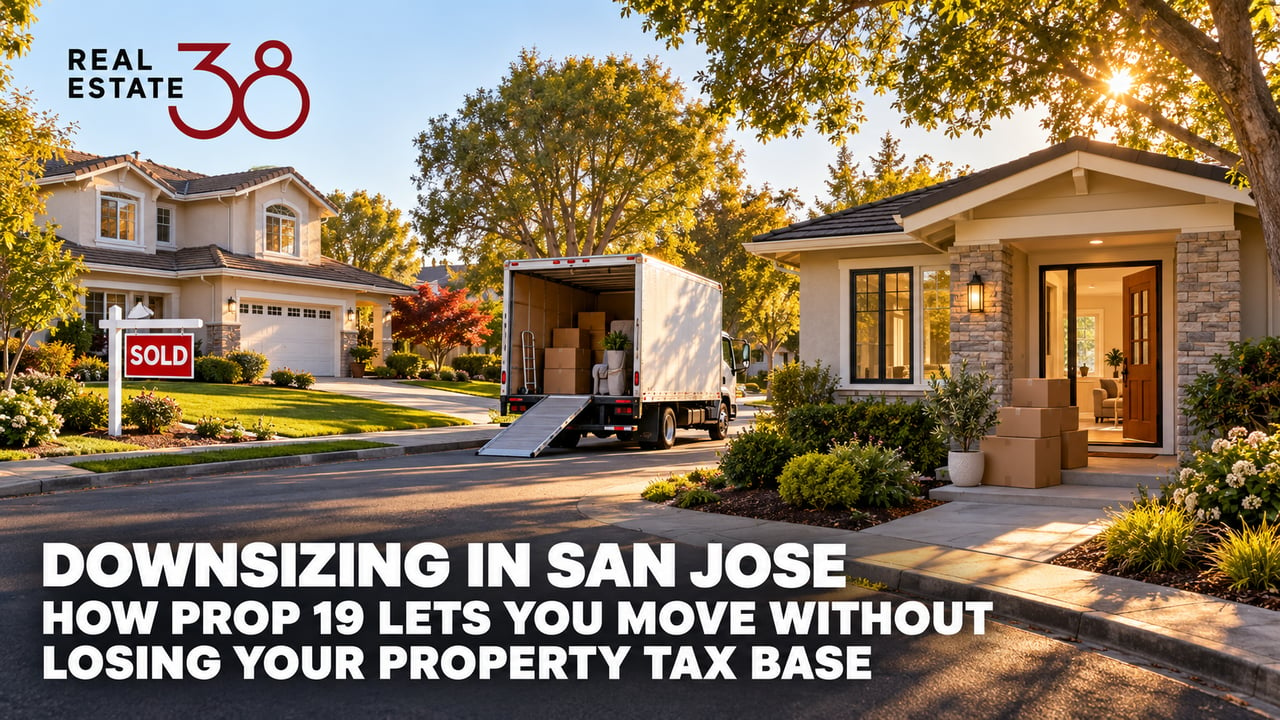
Downsizing in San Jose: How Prop 19 Lets You Move Without Losing Your Property Tax Base
Home Seller
Home Seller
If you’re thinking about downsizing in San Jose, the property tax question usually comes up first. Here’s the direct answer: if you’re 55 or older, Proposition 19 lets you transfer your current home’s property tax base to a new primary residence anywhere in California, up to three times in your lifetime. You don’t lose the low assessed value you’ve built up over years of ownership just because you’re moving to a smaller home. That removes the biggest financial objection I hear from empty nesters who want to downsize but are afraid their tax bill will reset to today’s market value.
I work with a lot of long-time San Jose homeowners whose kids have moved out and whose current home is bigger than they need. The house itself usually isn’t the hard part. The math is. Here’s how that math actually works, and what to verify before you list.
Proposition 19 passed in November 2020 and its base year value transfer provisions took effect April 1, 2021. It replaced the older Propositions 60, 90, and 110, which only let homeowners 55 and older transfer their property tax base once, usually within the same county or a short list of counties with reciprocal agreements.
Under Prop 19, you qualify if:
You can use this benefit up to three times in your lifetime, and the replacement home can be anywhere in California, not just Santa Clara County. The same provision also applies to severely disabled homeowners and to victims of certain disasters, though this article focuses on the age 55+ path most downsizers use. For the full rule text, see the California State Board of Equalization’s Proposition 19 page.
Here’s a simplified example to show why this matters. Say you bought your San Jose home years ago and its current assessed value, after Proposition 13’s annual cap on increases, is $480,000. At Santa Clara County’s typical effective tax rate of roughly 1.2%, you’re paying somewhere around $5,760 a year.
Now say you sell that home and buy a $1.3 million condo without using Prop 19. You’d be reassessed at the new purchase price, and your property tax would jump to roughly $15,600 a year. That’s about $9,800 more every year, just for moving to a smaller home.
With Prop 19’s base year value transfer, if your new home’s price falls within the adjustment rule below, you keep paying tax on close to that original $480,000 assessed value instead. Over ten years, that difference can add up to roughly six figures. These numbers are a simplified example, not a quote. Your actual assessed value, tax rate, and savings depend on your specific property and timing, which the Santa Clara County Assessor’s office can confirm for your situation.
No, but the price does affect how much of your tax base transfers. Here’s how the adjustment works:
If your replacement home’s price is at or below the applicable threshold, your full base year value transfers with no change. If it costs more than that threshold, your base year value still transfers, but the amount above the threshold gets added to your new taxable value. For most people downsizing to a smaller or less expensive home, the entire base year value carries over with nothing added on. Full details are on the Board of Equalization’s Prop 19 page.
You have a two-year window between your two transactions, and it runs in either direction. You can buy your new home first and sell your current one within the following two years, or sell first and buy within the following two years. At least one of the two transactions has to occur on or after April 1, 2021, which is already true for any sale happening now in 2026.
This two-year window matters because it gives you more room than people often assume. You don’t have to buy and sell in the same week, or even the same month, to keep your tax base.
Prop 19’s two-year window takes the tax clock off the table for this decision, but the financing and logistics questions are still real. Can you qualify for a new mortgage while still carrying your current home? Do you have the cash for a down payment before your sale closes? Is a contingent offer realistic in today’s San Jose market?
I walk through that full decision, including a worksheet for figuring out which sequence fits your situation, in my guide on buying before selling a San Jose home. Read that alongside this article if you’re still deciding on sequence.
Downsizing doesn’t have to mean a smaller version of the same thing. The right fit usually comes down to how much maintenance you want to keep doing yourself and how much space you actually use day to day.
San Jose has meaningfully different options by neighborhood, from walkable, lower-maintenance pockets to quieter single-family streets. My San Jose neighborhood guides are a useful starting point once you know which trade-off matters most to you.
This is separate from your property tax base, and it’s worth understanding before you list. If you’ve owned and lived in your home as your primary residence for at least two of the last five years, the IRS lets you exclude up to $250,000 of gain from your income if you’re single, or up to $500,000 if you’re married filing jointly. See IRS Topic No. 701 for the current rule.
Given how much San Jose home values have appreciated for long-time owners, your actual gain may be larger than that exclusion. I’m not a CPA, so if your numbers are close to or above those thresholds, it’s worth a conversation with your accountant before you set a listing date, not after.
You file claim form BOE-19-B, “Claim for Transfer of Base Year Value to Replacement Primary Residence for Persons at Least Age 55 Years,” within three years of buying or completing construction on your replacement home. You file with the assessor’s office in the county where your new home is located. If you’re staying in Santa Clara County, that’s the Santa Clara County Assessor’s Office, which currently charges a non-refundable $110 processing fee. If your new home is in a different California county, you’ll file with that county’s assessor instead, and fees may differ.
Before you commit to a specific replacement home, the Assessor’s office offers a Prop 19 transfer estimator you can use to project your new tax bill. I’d rather you run that number with real figures than guess.
Downsizing is both a sale and a purchase, and getting the sequence, the pricing, and the paperwork right on both sides is what protects the savings Prop 19 makes possible. My team and I help San Jose homeowners through both halves of this, from pricing and preparing your current home for sale to finding the right next place and coordinating the Prop 19 filing timeline alongside your lender and title company.
If you’re ready to see what your current home could sell for, start with a free home valuation. If you want the full seller-side roadmap first, my guide to selling your San Jose home walks through pricing, preparation, and timing in detail.
No. If your replacement home’s price is at or below the adjusted value of your original home (100% if you buy before you sell, 105% within the first year after, or 110% within the second year after), your full base year value transfers with nothing added. If your replacement home costs more than that, your base year value still transfers, with only the amount above the threshold added to your new taxable value.
Yes. Since Prop 19 took effect in April 2021, the base year value transfer applies to a replacement home anywhere in California, not just within the same county or a reciprocal county.
That’s enough. California’s rule requires that you, or a spouse residing with you, be at least 55 when the original property sells. If you co-own with someone other than a spouse, confirm your specific situation with the assessor’s office before you rely on it.
Up to three times, as long as at least one of your transfers happens on or after April 1, 2021, which is already true for any transfer completed today.
It still increases. Once your base year value transfers to the new home, it increases each year the same way any Proposition 13 assessed value does, by the state’s annual inflation factor, capped at 2%. You’re not freezing your tax bill permanently, you’re just avoiding a full reset to today’s market value.
In Santa Clara County, yes. The Assessor’s office currently charges a non-refundable $110 processing fee for the claim. If your replacement home is in a different county, check that county’s fee before you file.
Zaid Hanna
408-515-1613
www.re38.com
Stay up to date on the latest real estate trends.
October 5, 2026
October 2, 2026
October 2, 2026
October 2, 2026

October 2, 2026

October 2, 2026
You’ve got questions, and we can’t wait to answer them.