Buying Without an Agent in San Jose: What You Risk (and When It Makes Sense)
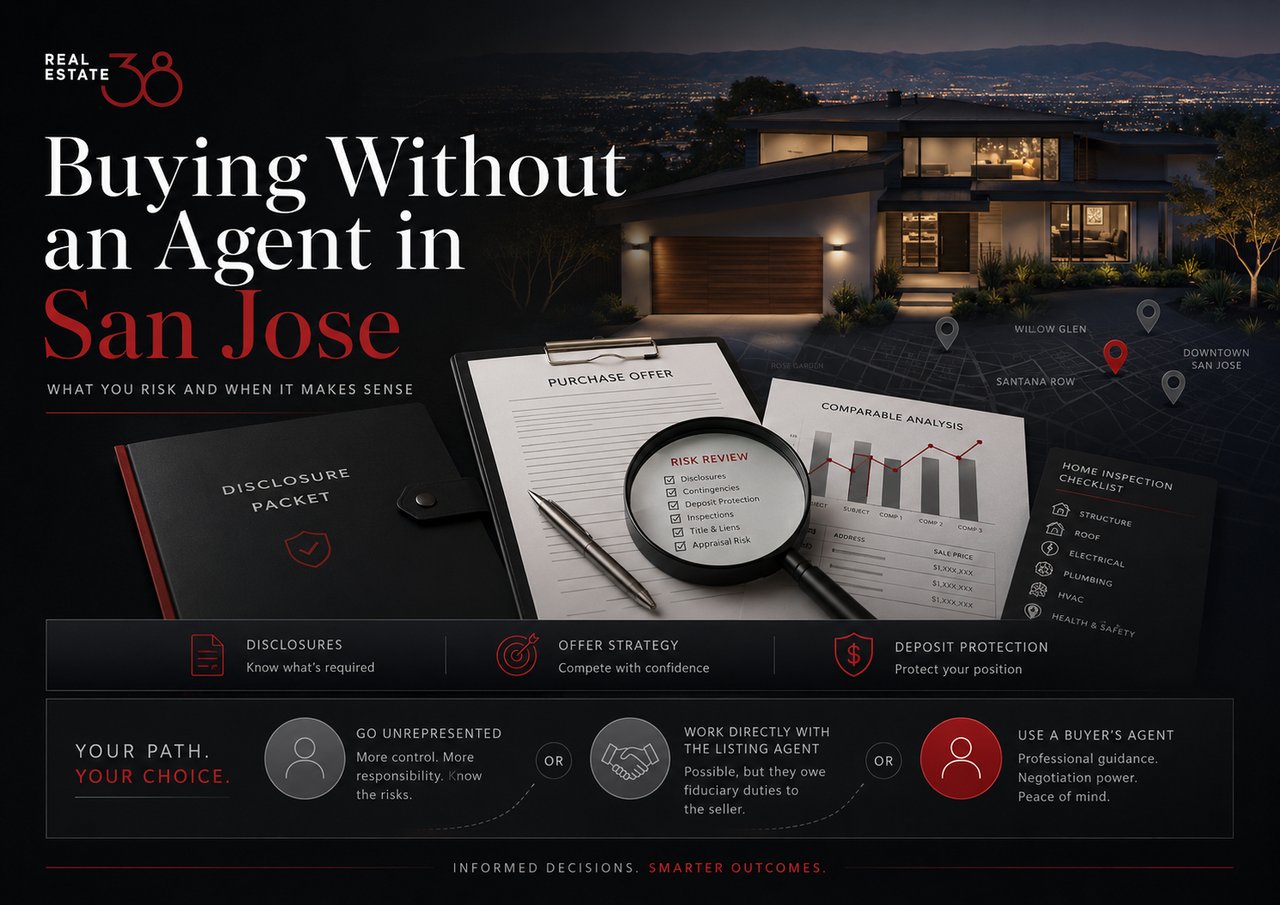
You can buy without an agent, but you should understand exactly what you are taking on before you do.
I say that because San Jose real estate is not a simple market. A buyer’s risk can change from one neighborhood to another, one price point to another, and one property condition to another.
A home in Willow Glen may have different risk factors than a home in Evergreen. A Cambrian property with additions may need a different review than a newer Berryessa townhouse. An Almaden Valley home near a strong school area may create a different offer strategy than a Downtown San Jose condo with HOA documents, rental rules, and building reserves to evaluate.
So the question is not, “Can I buy without an agent?”
The better question is:
“Do I fully understand what I am responsible for if I move forward without representation?”
That is what this guide is about.
If you are actively considering whether to represent yourself, contact the listing agent directly, or hire a buyer’s agent before touring homes, reviewing disclosures, writing an offer, or negotiating terms, I want you to understand the real tradeoffs first.
For a broader overview of the buying process, I also recommend reviewing my San Jose Home Buying Process Guide here: https://re38.com/san-jose-home-buying-process-guide
I understand why some buyers think about buying without their own agent.
Usually, it comes down to one of these reasons:
They think they may save money
They believe the listing agent will give them a better chance
They feel comfortable searching for homes online
They have bought before and feel experienced
They want to move quickly
They believe fewer people involved means a smoother transaction
They think the process is mostly paperwork
Some of those thoughts are reasonable. Buyers today have access to more information than ever. You can see listings, price history, photos, virtual tours, property records, and neighborhood data online.
But access to information is not the same as knowing how to interpret it.
In San Jose, the difference between a smart purchase and an expensive mistake often comes down to the details behind the listing.
The most common reason buyers consider going unrepresented is money.
They assume that if they do not have their own agent, there may be room to negotiate a better price or reduce the total cost of the transaction.
Sometimes that may be part of the discussion. But buyers need to be careful not to assume there is an automatic savings simply because they do not have their own agent.
Real estate compensation, seller agreements, listing terms, and offer structures can vary. The seller may already have an agreement with the listing brokerage. The listing agent may still be paid under that agreement. The seller may or may not adjust price based on your representation choice.
That is why I do not want buyers to make this decision based on an assumption.
The question should be:
“Am I actually saving enough to justify the risk I am taking on?”
And in many San Jose transactions, that risk can be significant.
One of the biggest misunderstandings I see is the difference between working with your own buyer’s agent and communicating with the listing agent.
The listing agent’s job is to represent the seller’s interests unless there is a separate agency arrangement. Their client is usually the seller. Their goal is usually to help the seller get the best possible outcome based on the seller’s priorities.
That does not mean the listing agent is dishonest. A professional listing agent should still communicate fairly and follow the rules.
But you should not confuse communication with representation.
There is a big difference between:
Asking the listing agent questions about the property
Having your own advisor review the property with your interests in mind
Understanding what the seller is required to disclose
Knowing which risks matter and which are manageable
Structuring an offer that protects your deposit
Negotiating from a position of data, not emotion
If you go directly to the listing agent, you need to understand who is advising whom.
San Jose is a competitive, expensive, and highly neighborhood-specific market.
A small mistake can cost a buyer a lot of money.
That mistake may not show up right away. It may show up after inspections, during appraisal, after closing, or years later when you try to sell the home.
Here are some of the risks I want buyers to think through.
In San Jose, many homes come with a large disclosure package before offers are due.
That package may include:
Seller disclosures
Inspection reports
Pest reports
Roof information
Foundation notes
Drainage observations
Permit history
Additions or remodeling details
Electrical, plumbing, HVAC, and sewer comments
Preliminary title report
Natural hazard disclosure
HOA documents for condos and townhomes
Meeting minutes, budgets, reserves, rental restrictions, and insurance details
A buyer can easily receive hundreds of pages.
The challenge is not just reading the documents. The challenge is understanding what matters, what is normal, what is negotiable, what could become expensive, and what could impact resale.
For example, a home in Rose Garden may have older systems that are common for the area but still important to price correctly. A Blossom Valley property may have drainage, roof, or pest concerns. A Downtown San Jose condo may require careful HOA review. A Santa Teresa home may look clean online but still have inspection details that affect your future maintenance costs.
Without guidance, buyers can miss risk because the issue is buried in a report, softened by technical language, or spread across multiple documents.
A home can photograph beautifully and still carry serious risk.
When I help buyers review homes in San Jose, I am not just looking at countertops and staging. I am looking for the issues that can affect safety, cost, insurance, financing, resale, and negotiation.
Some common areas that deserve careful review include:
Permits and unpermitted additions
Foundation movement or cracks
Drainage and grading issues
Roof age and roof condition
Termite damage or dry rot
Electrical panel age and wiring concerns
Plumbing materials and sewer condition
HVAC age and performance
Water intrusion or moisture signs
Retaining walls
Fireplace and chimney notes
Garage conversions
HOA restrictions and financial strength
Insurance concerns
Prior repairs that were not fully documented
This is especially important in San Jose because housing stock varies widely. You may compare a 1950s Cambrian home, a newer Evergreen home, an Almaden Valley property with hillside considerations, a Berryessa townhouse, and a Downtown condo, and each one requires a different risk review.
Another major risk is misunderstanding list price.
In San Jose, list price is not always the seller’s expected value. Sometimes a home is priced low to create competition. Sometimes it is priced at market. Sometimes it is priced too high and needs negotiation.
If you are buying without an agent, you need to know how to evaluate:
Comparable sales
Active competition
Pending activity
Days on market
Offer history
Price reductions
School area demand
Commute patterns
Property condition
Lot size and layout
Remodel quality
Neighborhood-specific buyer demand
A buyer can overpay by chasing competition without understanding value.
A buyer can also lose a great home by under-offering on a property that was strategically priced to create urgency.
Both mistakes are expensive.
The right offer strategy depends on the data, the seller’s motivation, the property’s condition, and the competition around that specific home.
Price gets the most attention, but terms are often where buyers expose themselves.
Your offer may include decisions around:
Inspection contingency
Appraisal contingency
Loan contingency
Disclosure review
Deposit amount
Contingency removal timelines
Closing timeline
Rent-back terms
Appraisal gap planning
Cash-to-close verification
Lender strength
Escalation strategy
Credits, repairs, or concessions
If you do not fully understand these terms, you may accidentally put your deposit at risk.
This is not just theory. In a competitive San Jose situation, buyers sometimes feel pressure to waive protections or shorten timelines to win. That can be appropriate in certain cases, but it should never be done casually.
Before removing or weakening a contingency, you should understand:
What you are giving up
What happens if the loan has a problem
What happens if the appraisal comes in low
What happens if inspections reveal an issue
What happens if you discover a disclosure concern
What happens if your cash-to-close changes
What happens if you cannot close on time
A strong offer is not just aggressive. A strong offer is strategic.
A buyer can have a pre-approval letter and still not be truly prepared to compete.
In San Jose, lender coordination can affect your offer strength, closing timeline, appraisal risk, and negotiating position.
Before writing an offer, buyers should understand:
Whether the pre-approval has been fully underwritten
How strong the lender is in competitive situations
Whether the lender can meet the proposed closing timeline
Whether the appraisal strategy is realistic
How much cash is needed to close
Whether reserves, RSUs, bonuses, or self-employment income are clearly documented
Whether there is any risk with loan conditions
Whether the lender can communicate quickly with the listing side
A buyer without representation may assume the lender handles everything financial. The lender is critical, but the lender is not evaluating property condition, seller motivation, neighborhood demand, inspection risk, HOA risk, or offer strategy in the same way a strong buyer’s agent should.
Negotiation is not only about asking for a lower price.
In San Jose, leverage depends on the situation.
A buyer needs to understand:
How long the home has been on the market
Whether the seller has already received offers
Whether the listing was previously canceled or reduced
Whether the seller needs a rent-back
Whether the seller wants a quick close
Whether the property has inspection concerns
Whether buyer demand is softening or increasing
Whether nearby homes are sitting or selling quickly
Whether the listing price was designed to attract multiple offers
If you do not understand the seller’s motivation and market conditions, you may push where you should be flexible, or give in where you should negotiate.
That is where buyers can lose leverage without realizing it.
Some buyers think going directly to the listing agent will give them an advantage.
Sometimes they believe the listing agent will “help both sides” or that the seller will prefer their offer because there is no separate buyer’s agent involved.
This is an area where buyers should slow down and understand the arrangement clearly.
Dual agency or direct-to-listing-agent situations can be complex. The key is to know who represents whom, what duties apply, what advice can or cannot be given, and whether you are getting independent guidance.
I am not saying these situations can never work. I am saying you should not walk into them casually.
Before you do, ask:
Who is representing my interests?
Who is advising me on price and risk?
Who is reviewing disclosures for me?
Who is helping me protect my deposit?
Who is negotiating on my behalf?
What happens if there is a disagreement after the offer is accepted?
These are not small questions.
There are situations where buying without an agent may make more sense.
For example:
You are an experienced investor
You buy and sell real estate regularly
You are purchasing from a family member
You are involved in an off-market transaction
You have professional real estate experience
You have legal, construction, lending, or investment expertise
You already have a strong team reviewing the deal
You understand disclosures, contracts, contingencies, and negotiation risk
Even then, I believe buyers still need strong data, disclosure review, and a clear negotiation strategy.
Experience helps, but it does not eliminate risk.
A seasoned investor can still misread neighborhood demand. A buyer with construction knowledge can still miss appraisal risk. A buyer with legal experience can still need market data. A buyer who knows the seller can still misunderstand value, timelines, title issues, or financing risk.
Buying without an agent may make sense in specific cases, but it should be a decision based on preparation, not hope.
You should think twice about buying without an agent if:
You are a first-time homebuyer
You are buying in a competitive San Jose neighborhood
You are unsure how to read disclosure packages
You do not know how to evaluate comparable sales
You are considering waiving contingencies
You do not understand appraisal gap risk
You are stretching financially
You are buying an older home
You are buying a condo or townhouse with HOA documents
The property has permit, foundation, drainage, roof, sewer, pest, electrical, plumbing, or HVAC concerns
You are relying heavily on financing
You are not sure how to protect your deposit
You are contacting the listing agent before understanding your options
This does not mean you cannot move forward.
It means you should slow down, get clear, and understand the responsibility you are accepting.
Before you decide to move forward without representation, ask yourself:
Do I know how to evaluate list price versus actual market value?
Do I understand the difference between active listings, pending sales, and closed comparable sales?
Do I know how competitive this specific home is likely to be?
Do I understand the seller’s motivation?
Do I know what the inspection report is really saying?
Do I know whether the pest report is minor, moderate, or serious?
Do I understand permit risk and how it may affect resale?
Do I know how to evaluate roof, foundation, drainage, electrical, plumbing, HVAC, and sewer concerns?
Do I understand the HOA documents, reserves, rental rules, insurance, and meeting minutes if it is a condo or townhouse?
Do I know what contingencies I should keep, shorten, or consider waiving?
Do I understand what could put my deposit at risk?
Do I know how strong my lender is compared to other buyers?
Do I understand appraisal risk and cash-to-close requirements?
Do I know what is negotiable and what is not?
Do I know how to structure an offer that is competitive without being reckless?
Do I have someone clearly representing my interests?
If you cannot answer these questions confidently, that is a sign you should get guidance before writing an offer.
A strong buyer’s agent should do much more than open doors and send listings.
In my opinion, a strong San Jose buyer’s agent should help you:
Understand the neighborhood and micro-market
Compare list price to true market value
Review comparable sales, pending activity, and active competition
Identify whether a home is underpriced, fairly priced, or overpriced
Review disclosures before you write
Flag inspection, pest, permit, foundation, drainage, roof, sewer, electrical, plumbing, HVAC, HOA, and title concerns
Coordinate with your lender before offer submission
Understand appraisal risk and cash-to-close exposure
Structure contingencies and timelines carefully
Protect your deposit
Communicate with the listing side strategically
Understand seller motivation
Write an offer that matches the situation
Negotiate without weakening your position
Help you decide when to compete and when to walk away
That is the level of advice buyers should expect.
At Real Estate 38, our buyer process is built around data, risk review, negotiation strategy, and protection. We help buyers evaluate homes, review disclosures, compare comps, analyze offer strength, coordinate with lenders, and make decisions with confidence.
You can learn more about how we help buyers here: https://re38.com/buying
I do not believe every buyer needs to be pressured into hiring an agent.
That is not the point.
The point is that if you buy without an agent, you need to know what you are taking on.
You are responsible for understanding the property, the disclosures, the value, the offer terms, the risks, the timelines, the negotiation strategy, the lender coordination, and the deposit exposure.
In a market like San Jose, that is a lot to carry alone.
Whether you are looking in Willow Glen, Cambrian, Almaden Valley, Evergreen, Berryessa, Blossom Valley, Santa Teresa, Rose Garden, Downtown San Jose, or another part of the city, the right decision depends on your experience, your risk tolerance, the home, the competition, and the quality of the information in front of you.
Buying without an agent can make sense in certain situations, but it should be done carefully and with full awareness of the tradeoffs.
Before you write an offer, contact a listing agent directly, waive protections, or decide to go unrepresented, I would rather you understand the data, the risks, the property condition, the disclosure package, the offer strategy, and the deposit exposure first.
A confident buyer is not just someone who moves fast.
A confident buyer knows what they are buying, why they are offering what they are offering, what risks they are accepting, and how to protect themselves before they sign.
If you are thinking about buying a home in San Jose and want help evaluating whether you should represent yourself, work directly with the listing agent, or hire a buyer’s agent, reach out before you make the next move.
You can also contact us here: https://re38.com/contact
Zaid Hanna
408-515-1613
www.re38.com
Stay up to date on the latest real estate trends.

July 24, 2026

July 24, 2026

July 22, 2026

July 18, 2026

July 14, 2026
July 6, 2026
You’ve got questions, and we can’t wait to answer them.