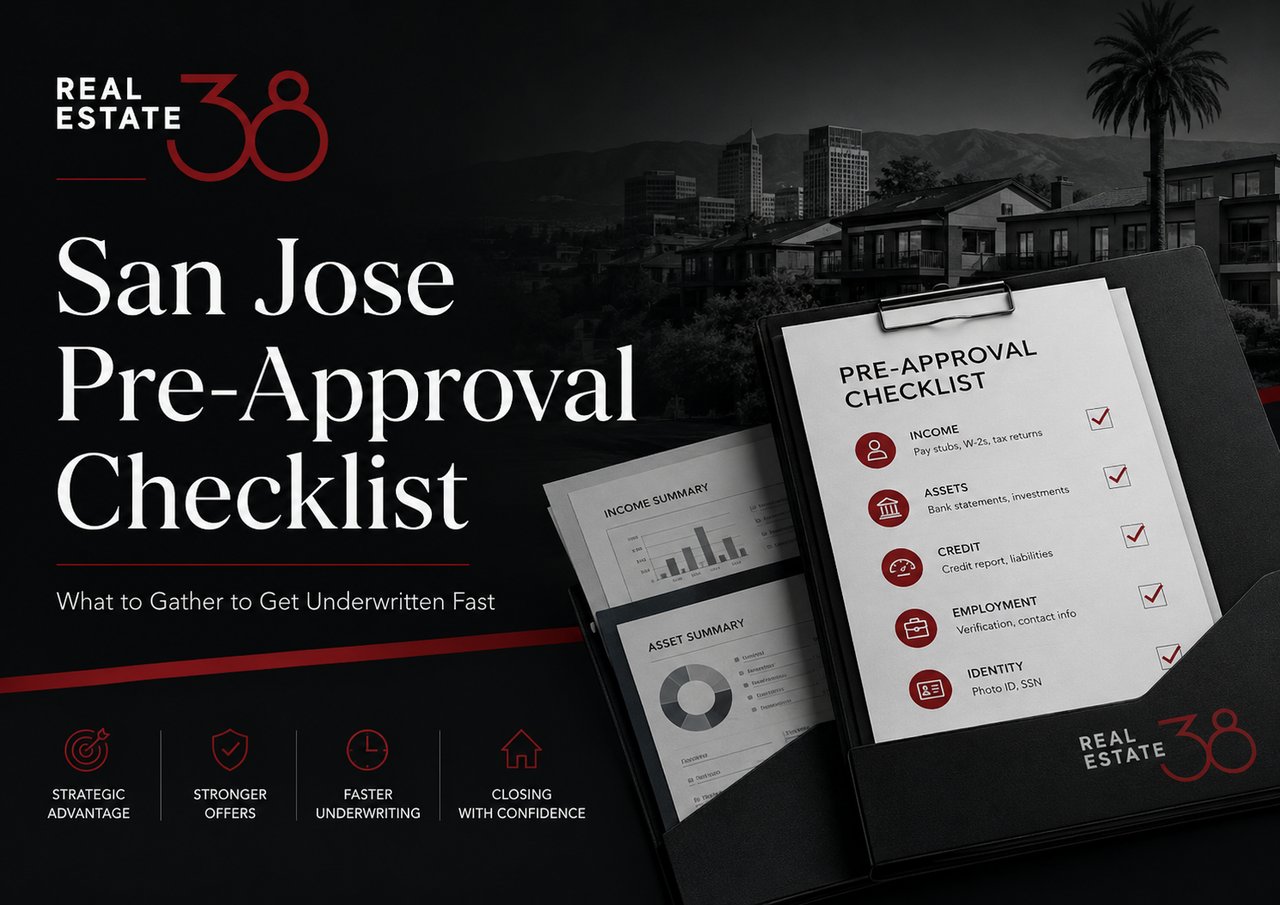
San Jose Pre-Approval Checklist: What to Gather to Get Underwritten Fast
Home Buyer
Home Buyer
When you are buying a home in San Jose, your pre-approval is not just a budget estimate.
It is part of your offer strategy.
In a competitive market like San Jose, where buyers may be looking in Willow Glen, Cambrian, Almaden Valley, Evergreen, Berryessa, Blossom Valley, Santa Teresa, Rose Garden, Downtown San Jose, Campbell, Santa Clara, Sunnyvale, or Cupertino, the quality of your pre-approval can affect how confidently you shop, how quickly you write, and how seriously a seller views your offer.
A weak pre-approval can create hesitation.
A strong pre-approval can create confidence.
The difference usually comes down to preparation. Did the lender actually review your documents? Did underwriting look at your income, assets, credit, debts, and employment? Are there questions that still need to be answered before you can close?
In San Jose, a strong pre-approval is not just about knowing your budget. It is about being ready to move fast, write confidently, and reduce surprises once you are in contract.
That is why I like buyers to get organized before they start touring homes, not after they find one they love.
For a broader overview of loan options, approval strategy, and mortgage planning, you can also review our San Jose Home Loan & Mortgage Guide. If you are already preparing to buy, our San Jose home buying page is a good next step.
San Jose real estate moves quickly when the right home is priced well, presented well, and located in a desirable neighborhood.
That does not mean every home gets multiple offers. But when a strong property hits the market, serious buyers need to be ready.
A listing agent and seller are usually looking at more than the offer price. They are also evaluating risk.
They want to know:
This is why a strong pre-approval matters.
It helps your offer look cleaner. It helps reduce uncertainty. It gives the listing side more confidence that you are not just interested, but prepared.
In San Jose, that matters.
Not all lender letters are the same.
A lot of buyers assume that once they have a letter, they are ready to compete. That is not always true.
Here is how I explain the difference.
A pre-qualification is usually the lightest version.
The lender may ask for basic information about your income, assets, debts, and credit. In many cases, the information is self-reported or only lightly reviewed.
It can be helpful early in the process, but I would not rely on it as your final offer strategy in San Jose.
A pre-qualification may tell you what could be possible.
It does not always prove that the file has been deeply reviewed.
A pre-approval is stronger.
The lender typically reviews credit, income documents, asset documents, employment information, and basic debt obligations. This gives you and your real estate team a much clearer picture of your buying power.
For many San Jose buyers, this is the minimum level of preparation I want before we start writing serious offers.
But even pre-approvals can vary.
Some lenders review documents carefully. Others issue letters before all details are fully verified. That difference matters once you are in contract.
A fully underwritten approval is usually the strongest position before you have a property address.
This means the buyer’s file has been reviewed more deeply by underwriting, subject to final property approval, appraisal, title, insurance, and any remaining conditions.
Not every buyer needs this, and not every lender offers it in the same way. But when speed and certainty matter, it can make your offer feel stronger.
For competitive San Jose homes, especially with jumbo financing, RSU income, bonus income, commission income, self-employment, or complex assets, deeper review upfront can help avoid surprises later.
The best time to organize your documents is before you start falling in love with homes.
Once you find the right property, the clock starts moving fast. You may need to review disclosures, compare comps, discuss offer terms, contact your lender, and make decisions quickly.
You do not want to be searching for old tax returns, explaining large deposits, or trying to locate missing statements while another buyer is already writing.
Here is what most lenders commonly need.
Gather the basics first:
These items seem simple, but missing or inconsistent information can slow down the file.
Most lenders want to understand your work history and stability.
Be ready to provide:
In Silicon Valley, job changes are common. A new role does not automatically create a problem, but the lender needs to document it correctly.
If you are a W-2 employee, your lender may ask for:
For straightforward salaried buyers, this may be simple.
For buyers with bonus, commission, RSUs, or changing compensation, the review can be more detailed. We will go deeper on those topics in later Lending pillar blogs, but the key point is this: do not assume all income counts the same way.
A lender needs to verify what income is stable, recurring, and usable for qualification.
Many San Jose and Silicon Valley buyers have compensation that goes beyond base salary.
At a high level, lenders may ask for:
This can be especially important for buyers working in tech, sales, leadership, or performance-based roles.
The lender is not just asking how much you earned. They are trying to determine what income can be counted reliably.
Self-employed buyers often need more documentation because lenders must understand both personal and business income.
At a high level, lenders may request:
Self-employed approval can be very doable, but it is rarely something I want buyers to rush at the last minute.
If you are self-employed and planning to buy in San Jose, preparation matters.
Your lender will need to verify where your funds are coming from.
Be ready to provide:
Most lenders want full account statements, not screenshots.
They also need to see that your funds are seasoned, documented, and available for down payment, closing costs, and reserves.
Gift funds are common, especially for first-time buyers or buyers receiving family support.
If gift money is part of your plan, tell the lender early.
They may need:
Do not move gift money casually without checking with your lender first. The paper trail matters.
Large deposits can create underwriting questions.
Examples include:
A large deposit is not automatically a problem.
An undocumented large deposit can become a problem.
Before you move money, liquidate investments, or transfer funds between accounts, ask your lender how they want it documented.
Lenders also review your debts and monthly obligations.
Be ready to disclose:
One mistake I see buyers make is focusing only on income and down payment.
Debt matters too.
Your lender is looking at your full financial picture, including your debt-to-income ratio and any obligations that affect your ability to qualify.
Not every buyer needs to provide every tax document, but many do.
Depending on your profile, the lender may request:
This is especially important if you have rental income, business income, partnership income, commission income, or complicated tax deductions.
The goal is not just to collect paperwork.
The goal is to help the lender understand your income clearly before you are under contract.
A pre-approval can slow down when the lender has unanswered questions.
Some of the most common issues include:
Most of these problems are avoidable.
The key is to organize early, be transparent with your lender, and avoid financial changes before approval.
Once you are preparing to buy, do not treat your finances casually.
Before your loan is fully approved and closed, avoid:
Even if you have strong income and strong credit, these moves can create questions.
And in a San Jose purchase, delays can put pressure on your contract, your contingency timelines, and your closing date.
Many San Jose buyers are using jumbo financing because local home prices are high.
Jumbo loans often come with more detailed review.
That can include:
This does not mean jumbo loans are bad.
It just means buyers need to prepare earlier.
If you are buying in neighborhoods like Almaden Valley, Willow Glen, Rose Garden, Cambrian, Evergreen, Santa Clara, Sunnyvale, or Cupertino, jumbo financing may be part of the conversation. The stronger your documentation is upfront, the easier it is to move with confidence when the right home appears.
A strong pre-approval helps in two ways.
First, it helps you understand your real budget. Not just the maximum number on paper, but the payment, cash needed, reserves, and comfort level.
Second, it helps the offer look cleaner to the listing agent and seller.
When we submit an offer, the listing side wants to feel confident that the buyer can perform. A strong lender letter, a responsive lender, and a well-documented file can all help.
It may not replace price. It may not replace terms. But it can reduce uncertainty.
That matters when a seller is comparing offers.
A buyer who is organized, verified, and ready often feels safer than a buyer whose financing still has unanswered questions.
At Real Estate 38, we do not want buyers guessing their way through the process.
Before we start writing offers, I want to understand:
We also help buyers connect with trusted lenders who understand San Jose, Silicon Valley compensation, fast timelines, and competitive offer situations.
That matters because buying here is not just about getting a loan.
It is about creating a plan.
We help buyers prepare early, understand offer strength, avoid surprises, and move faster when the right home shows up.
If you are planning to buy, you can start with our San Jose home buying resources, review the San Jose Home Loan & Mortgage Guide, or contact us directly before you start touring homes.
A strong San Jose pre-approval is more than a lender letter.
It is a strategy tool.
It helps you shop with clarity, move faster, write with confidence, and reduce surprises once you are in contract.
If you are serious about buying in San Jose, do not wait until you find the right home to get organized. Gather your documents early. Make sure your lender has reviewed the important details. Understand whether your approval is strong enough to compete.
The earlier we know where you stand, the better we can help you prepare.
If you are thinking about buying in San Jose, reach out before you start touring homes, before you submit an offer, or before you assume your pre-approval is strong enough to compete.
Zaid Hanna
408-515-1613
www.re38.com
Stay up to date on the latest real estate trends.

October 5, 2026

October 2, 2026

October 2, 2026

October 2, 2026

October 2, 2026

October 2, 2026
You’ve got questions, and we can’t wait to answer them.