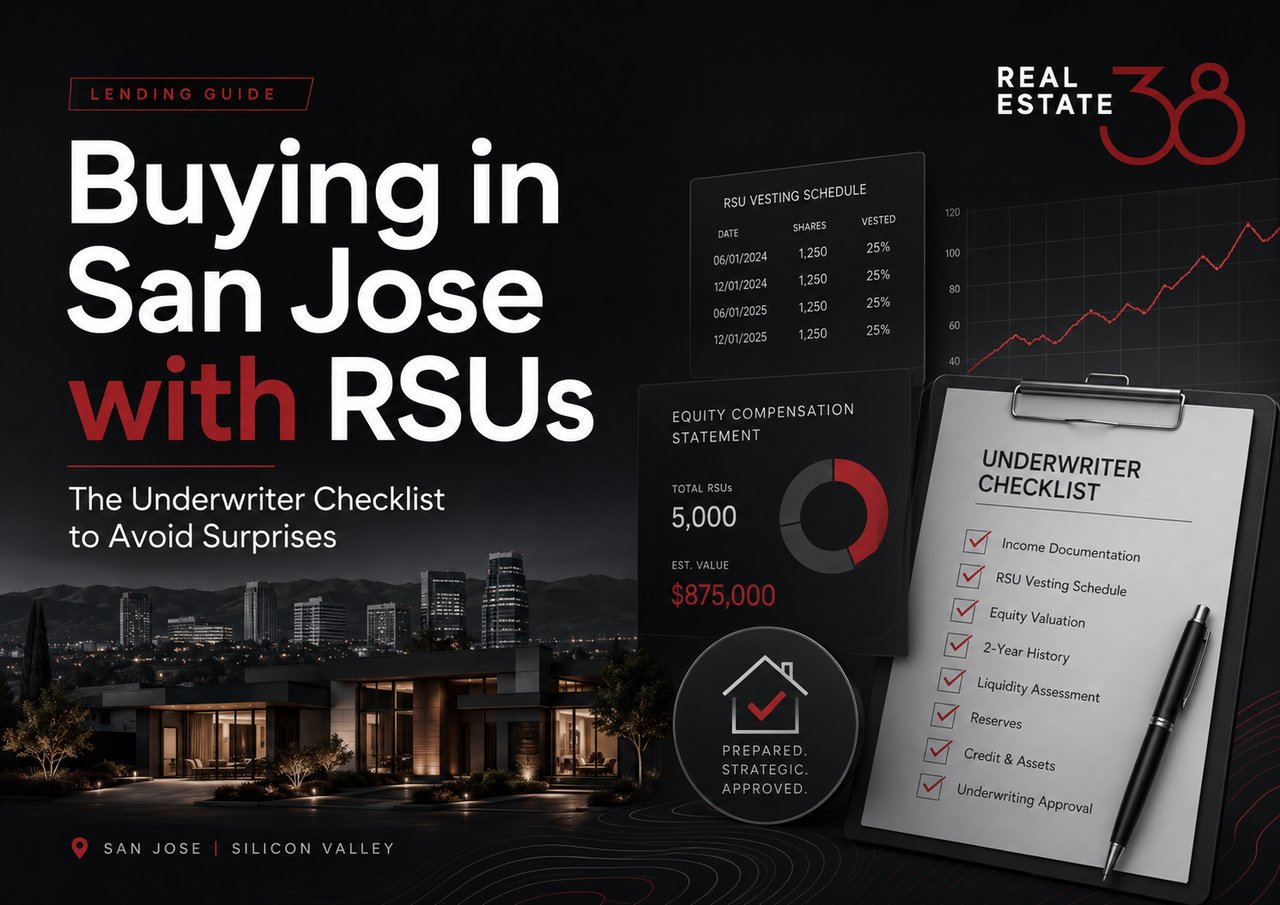
Buying in San Jose with RSUs: The Underwriter Checklist to Avoid Surprises
Home Buyer
Home Buyer
For many San Jose and Silicon Valley buyers, RSUs are not just a nice bonus. They are a real part of total compensation, savings, down payment planning, and monthly affordability.
But here is the part that catches a lot of buyers off guard: lenders do not always treat RSU income the same way buyers think about it.
You may look at your offer letter, your company portal, your stock grants, and your total compensation package and feel confident about your buying power. But an underwriter may separate your base salary, vested RSUs, unvested RSUs, bonus income, and liquid assets into very different categories.
That is why I tell San Jose tech buyers this all the time:
In San Jose, RSU income can be a powerful part of your buying power, but only if it is documented correctly and reviewed by the right lender before you start writing offers.
This matters even more when you are buying in competitive areas like Willow Glen, Cambrian, Almaden Valley, Evergreen, Berryessa, Blossom Valley, Santa Teresa, Rose Garden, Downtown San Jose, Campbell, Santa Clara, Sunnyvale, Mountain View, and Cupertino, where many buyers are using strong compensation packages to compete.
Before you start touring homes or writing offers, make sure your RSU income has been reviewed properly. If you need a broader overview of the lending process, I also recommend starting with our San Jose Home Loan & Mortgage Guide.
San Jose is one of the most tech-driven housing markets in the country. A large percentage of serious buyers work in technology, engineering, product, finance, sales, operations, or leadership roles where compensation may include:
On paper, that can create strong buying power.
But mortgage underwriting is not based on what your compensation could be. It is based on what the lender can document, verify, and use under its guidelines.
That is where the difference matters.
A buyer may say, “My total compensation is $450,000.”
The lender may say, “We can use your base salary, some RSU history, and certain verified assets, but not all future grants.”
That difference can change your approved purchase price, monthly payment comfort zone, reserve requirements, down payment strategy, and offer strength.
Every lender can review RSU income a little differently, especially for jumbo loans, portfolio loans, and higher-priced San Jose purchases.
In general, lenders are trying to answer a few key questions:
The lender wants to know whether your RSU income has been consistent over time. A one-time grant may not be treated the same as a recurring pattern of vested RSUs.
They may look at your W-2s, pay stubs, year-end income, equity statements, and vesting history to understand what has actually been received.
Many lenders like to see a two-year history of RSU income. That does not always mean you are automatically disqualified if you have less, but it does mean the lender may ask more questions.
For buyers who recently changed companies, received a new grant, or moved into a higher compensation role, this review becomes more important.
Lenders may review your unvested RSUs, current grant schedule, refresh grants, employer history, and vesting timeline to determine whether future receipt is likely.
The key word is likely.
Future RSUs may help support the file, but buyers should not assume every unvested share will count as qualifying income.
RSU income is tied to stock value. If the stock price moves up or down, the lender may calculate income differently than you expect.
Some lenders may average prior income. Some may haircut the value. Some may use a conservative method based on current stock price. Others may have overlays that are stricter than expected.
This is one reason I do not want buyers waiting until they are in contract to discover how their RSU income is being counted.
In San Jose, many buyers are shopping in price ranges where jumbo financing is common. Jumbo loans often come with more detailed documentation requirements.
That may include deeper review of:
The stronger the file is upfront, the cleaner the offer can look later.
If you are a San Jose buyer with RSUs, do not wait until you find the house to start collecting documents.
The best time to organize your RSU file is before you tour homes, before you assume your total compensation will qualify, and definitely before you write an offer.
Here is what I would gather early.
The goal is simple: let the lender review the real file early so you know your true buying power before emotions enter the picture.
For buyers who are ready to start the home search, our San Jose home buying page explains how we help buyers prepare, compete, and move with confidence.
Use this checklist before you begin seriously shopping for a home in San Jose.
Do not lump everything together as “total comp.”
Break your compensation into:
This helps the lender determine what can be used for qualifying income versus what may only count as assets or reserves.
Ask the lender directly:
The answer matters because not every lender will qualify you the same way.
Your vesting schedule can affect your approval, reserves, down payment timing, and comfort level after closing.
If a large vest is coming soon, that may change your cash position. If a prior grant is ending, that may also affect how the lender views future income.
Before you sell shares, move funds, or transfer money between accounts, speak with the lender.
This is especially important if the stock sale will be used for:
A clean paper trail matters.
If the lender cannot clearly source the money, underwriting may slow down.
Large deposits can trigger underwriting questions, even when the money is completely legitimate.
For RSU buyers, large deposits often come from:
The solution is not to hide the movement of money. The solution is to document it clearly.
A basic pre-approval is not always enough in a competitive San Jose market.
If you have RSUs, variable income, jumbo financing, or complex assets, I want the lender to review the file deeply before we write offers.
That can make the difference between a confident offer and a stressful escrow.
RSU income can be very helpful, but the problems usually come from assumptions, missing documents, or timing.
Here are the issues I see buyers run into.
This is the biggest mistake.
Your total compensation package may be strong, but the lender may not count every piece toward qualifying income.
Base salary is usually the cleanest. RSUs, bonus income, and commission income may require more history and documentation.
If you do not have two full years of RSU income, the lender may still have options, but the file may require a more careful review.
This is common for buyers who recently joined a new company, received a major promotion, changed roles, or moved from a private company to a public company.
A pay stub may show some RSU income, but that does not always tell the full story.
The lender may also want to see the grant, vesting schedule, stock plan statement, and proof of future continuity.
If the company stock price drops, the lender may use a more conservative income calculation.
That does not mean you cannot buy. It means the file needs to be reviewed with realistic numbers.
If you sell stock for the down payment, the lender may ask for documentation showing:
That is normal, but it can become a problem if the paperwork is incomplete.
Transferring funds between multiple accounts right before underwriting can create extra questions.
Before moving money, especially from brokerage accounts, I recommend talking to the lender first so the paper trail stays clean.
This is a major issue in San Jose.
A lender who mostly handles simple W-2 files may not be the right fit for a tech buyer with RSUs, jumbo financing, bonus income, or complex assets.
The right lender should know how to explain the file, document the income, and communicate clearly with the listing agent when needed.
In San Jose, the strength of your offer is not only about price.
Listing agents and sellers also care about certainty.
If your RSU-backed pre-approval is clean, complete, and reviewed by a strong lender, it can help your offer feel safer.
That matters when you are competing in neighborhoods like Willow Glen, Cambrian, Almaden Valley, Evergreen, Berryessa, Blossom Valley, Santa Teresa, Rose Garden, Downtown San Jose, Campbell, Santa Clara, Sunnyvale, Mountain View, and Cupertino.
A strong file can help show that:
This can give the listing side more confidence, especially when sellers are comparing multiple offers.
At Real Estate 38, we work with a lot of San Jose and Silicon Valley buyers whose compensation is more complex than a simple base salary.
That includes buyers with RSUs, bonus income, commission income, self-employment income, investment assets, and jumbo loan needs.
My role is not to replace the lender. My role is to help you prepare the right way before the search gets serious.
Here is how we help:
The goal is not just to get pre-approved.
The goal is to know your real buying power, write cleaner offers, and reduce surprises after you are in contract.
If you are buying in San Jose with RSUs, do not wait until you find the house to ask whether your stock compensation counts.
Get the review done early.
Before you assume your total compensation will qualify, talk to the right lender. Before you sell stock, move funds, or shift money between accounts, get guidance. Before you submit an offer, make sure your pre-approval is strong enough for the price range and neighborhood you are targeting.
That preparation can save time, protect your offer, and help you compete with more confidence.
If you are thinking about buying in San Jose, Campbell, Santa Clara, Sunnyvale, Mountain View, Cupertino, or the surrounding Silicon Valley market, and your compensation includes RSUs, let’s talk before you start touring homes.
We can help you understand what to prepare, connect with the right lending resources, and build a strategy that matches your real buying power.
For help planning your next step, visit our contact page.
Zaid Hanna
408-515-1613
www.re38.com
Stay up to date on the latest real estate trends.

October 5, 2026

October 2, 2026

October 2, 2026

October 2, 2026

October 2, 2026

October 2, 2026
You’ve got questions, and we can’t wait to answer them.